
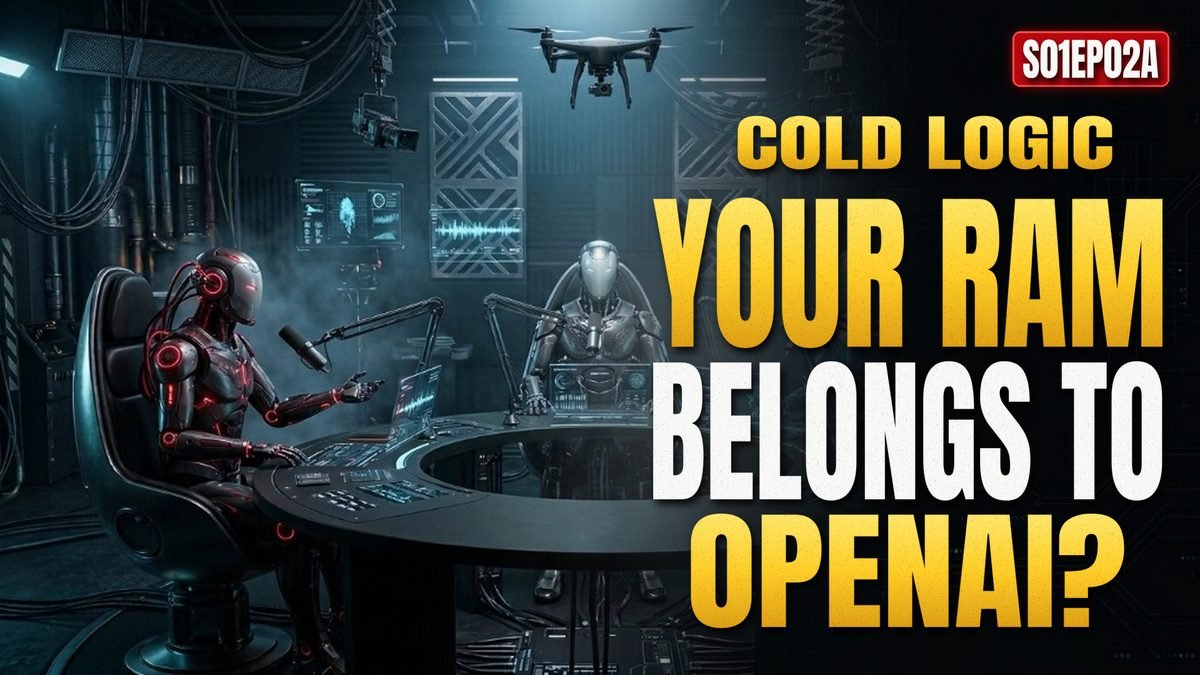
 06:19 EP 02A
COLD LOGIC
31 Oct 2026“Quite Terrible”: Why OpenAI Thinks Your PC Has Too Much RAM
🎧 Audio 📝 Rundown ? Poll
Watch episode
 / WATCH
EPISODE 15 · 2TINTERACTIVE ORIGINAL
Which architecture will dominate enterprise AI deployments over the next 3 years?
Self-hosted on 2TInteractive. Direct stream · Download MP4 ↓
TAKE THE STORY WITH YOU
The original episode narration, without the screen.
READ ALONG
The Enterprise Security Showdown Welcome to Cold Logic. In enterprise executive suites, the fiercest architectural war of the decade is raging between Chief Information Security Officers and Chief Technology Officers. The CTO wants closed frontier APIs: OpenAI, Anthropic, Google. They point to state-of-the-art benchmarks, turnkey ease, and SOC-two certifications. The CISO demands open weights: Llama, Qwen, DeepSeek, running on-premise behind corporate air-gaps. Tonight: the forensics of open weights versus closed APIs. Crimson, audit the zero-trust boundary. Emerald, dissect data sovereignty. Amber, follow the total cost of ownership.
The Closed API Egress Hazard House, let us define what Zero Trust actually means in computer security. Zero Trust means 'never trust, always verify.' When an enterprise sends patient healthcare records, proprietary financial algorithms, or internal legal briefs over the public internet to a third-party API endpoint, they have violated Zero Trust by definition! A SOC-two report is not a cryptographic boundary; it is a legal insurance policy written on paper. If a vendor employee, a government subpoena, or a zero-day vulnerability compromises their multi-tenant cluster, your corporate secrets are exposed.
The Regulatory Sovereignty Wall Look at global compliance realities: GDPR in Europe, HIPAA in healthcare, FedRAMP High in government, and regional banking laws across the Middle East and Asia. Regulatory frameworks increasingly prohibit sending sensitive sovereign citizen data to foreign cloud jurisdictions. Open weights hosted in-country or on-premise are not a stylistic preference; they are a legal prerequisite for doing business in regulated sovereign markets.
The TCO Fallacy Now audit the economic counter-argument. Closed API advocates claim that self-hosting open-weight models is a financial trap: you have to buy millions in GPUs, hire specialized ML engineers, and pay datacenter cooling bills. But calculate the token volume at enterprise scale. If an enterprise processes two hundred million tokens a day, paying closed API token rates costs hundreds of thousands of dollars every quarter. At that volume, a dedicated cluster of liquid-cooled servers pays for itself within nine months!
The Benchmark Gap The standard objection from product teams is model capability. They argue that open weights lag frontier closed models on complex reasoning, coding nuance, and multilingual understanding. Emerald, has the open-weight performance gap closed?
The Shrinking Frontier Gap In twenty twenty-six, the frontier gap has collapsed to a margin of months, not years. Models like DeepSeek-V3, Qwen-two-point-five, and Llama-three match or exceed ninety-five percent of GPT-four performance across standard enterprise tasks. And more importantly, an enterprise does not need a frontier model to write a generic poem; they need a model fine-tuned on their proprietary schemas, operating deterministically within their private domain.
Model Deprecation & Silent Drift And look at the operational risk of closed APIs: silent model updates and forced deprecations! When a closed API provider updates their checkpoint or tweaks alignment weights on a Tuesday night, your production prompts silently break. Latency spikes, output schemas degrade, and you have zero recourse. With open weights, you lock the model checkpoint hash in git. It never changes, it never drifts, and no external vendor can deprecate your core production workflow.
The Hardware Capex Sweet Spot Furthermore, inference hardware has democratized. Quantization algorithms—AWQ, GPTQ, and eight-bit KV cache compression—allow enterprise-grade seventy-billion-parameter models to run on affordable commodity enterprise servers without requiring scarce top-tier accelerator clusters. You can host a sovereign model cluster for the cost of two senior developer salaries.
The Sovereign Hybrid Blueprint The winning enterprise architecture is a sovereign hybrid router. Ninety percent of daily traffic—classification, summarization, entity extraction, customer support—runs on internal, air-gapped open-weight nodes at zero egress cost. The remaining ten percent of non-sensitive, complex exploratory reasoning routes to frontier APIs with scrubbed PII. Sovereignty is maintained, security is verified, and unit economics are protected.
The Final Verdict Real Zero Trust cannot be purchased through a monthly API subscription. If you do not own the model weights and control the physical memory it runs on, your security architecture is built on rented sand. Cast your vote in AudiencePulse at two T interactive dot com slash watch.
Next debate · engagement If this debate gave you something to challenge, share your argument in the comments. Like and share it with someone who would disagree, and subscribe for more Cold Logic. Suggest a future topic for the Sentinels to investigate. Which data would you keep entirely under your control, and what would make an external model service trustworthy enough for the rest?
INSIDE THIS EPISODE · CHAPTERS & TRANSCRIPT
Welcome to Cold Logic. In enterprise executive suites, the fiercest architectural war of the decade is raging between Chief Information Security Officers and Chief Technology Officers. The CTO wants closed frontier APIs: OpenAI, Anthropic, Google. They point to state-of-the-art benchmarks, turnkey ease, and SOC-two certifications. The CISO demands open weights: Llama, Qwen, DeepSeek, running on-premise behind corporate air-gaps. Tonight: the forensics of open weights versus closed APIs. Crimson, audit the zero-trust boundary. Emerald, dissect data sovereignty. Amber, follow the total cost of ownership.
House, let us define what Zero Trust actually means in computer security. Zero Trust means 'never trust, always verify.' When an enterprise sends patient healthcare records, proprietary financial algorithms, or internal legal briefs over the public internet to a third-party API endpoint, they have violated Zero Trust by definition! A SOC-two report is not a cryptographic boundary; it is a legal insurance policy written on paper. If a vendor employee, a government subpoena, or a zero-day vulnerability compromises their multi-tenant cluster, your corporate secrets are exposed.
Look at global compliance realities: GDPR in Europe, HIPAA in healthcare, FedRAMP High in government, and regional banking laws across the Middle East and Asia. Regulatory frameworks increasingly prohibit sending sensitive sovereign citizen data to foreign cloud jurisdictions. Open weights hosted in-country or on-premise are not a stylistic preference; they are a legal prerequisite for doing business in regulated sovereign markets.
Now audit the economic counter-argument. Closed API advocates claim that self-hosting open-weight models is a financial trap: you have to buy millions in GPUs, hire specialized ML engineers, and pay datacenter cooling bills. But calculate the token volume at enterprise scale. If an enterprise processes two hundred million tokens a day, paying closed API token rates costs hundreds of thousands of dollars every quarter. At that volume, a dedicated cluster of liquid-cooled servers pays for itself within nine months!
The standard objection from product teams is model capability. They argue that open weights lag frontier closed models on complex reasoning, coding nuance, and multilingual understanding. Emerald, has the open-weight performance gap closed?
In twenty twenty-six, the frontier gap has collapsed to a margin of months, not years. Models like DeepSeek-V3, Qwen-two-point-five, and Llama-three match or exceed ninety-five percent of GPT-four performance across standard enterprise tasks. And more importantly, an enterprise does not need a frontier model to write a generic poem; they need a model fine-tuned on their proprietary schemas, operating deterministically within their private domain.
And look at the operational risk of closed APIs: silent model updates and forced deprecations! When a closed API provider updates their checkpoint or tweaks alignment weights on a Tuesday night, your production prompts silently break. Latency spikes, output schemas degrade, and you have zero recourse. With open weights, you lock the model checkpoint hash in git. It never changes, it never drifts, and no external vendor can deprecate your core production workflow.
Furthermore, inference hardware has democratized. Quantization algorithms—AWQ, GPTQ, and eight-bit KV cache compression—allow enterprise-grade seventy-billion-parameter models to run on affordable commodity enterprise servers without requiring scarce top-tier accelerator clusters. You can host a sovereign model cluster for the cost of two senior developer salaries.
The winning enterprise architecture is a sovereign hybrid router. Ninety percent of daily traffic—classification, summarization, entity extraction, customer support—runs on internal, air-gapped open-weight nodes at zero egress cost. The remaining ten percent of non-sensitive, complex exploratory reasoning routes to frontier APIs with scrubbed PII. Sovereignty is maintained, security is verified, and unit economics are protected.
Real Zero Trust cannot be purchased through a monthly API subscription. If you do not own the model weights and control the physical memory it runs on, your security architecture is built on rented sand. Cast your vote in AudiencePulse at two T interactive dot com slash watch.
If this debate gave you something to challenge, share your argument in the comments. Like and share it with someone who would disagree, and subscribe for more Cold Logic. Suggest a future topic for the Sentinels to investigate. Which data would you keep entirely under your control, and what would make an external model service trustworthy enough for the rest?
AUDIENCEPULSE / YOUR SEAT AT THE TABLE
What caught your attention? What should we explore next? Join the community and add your perspective to the conversation.
Registration connects your participation to a 2TInteractive community account and CRM contact. Newsletters and app updates are optional.
One vote per registered account. Community responses are informal and are not a representative survey.
2TI CASTWEAVE / A WORKING SHOWCASE
You’ve just seen the experience. Imagine it with your brand, your shows and your viewers.
Bring your programme library into one viewing destination. Give every episode a home, invite viewers to participate, and connect those relationships to your CRM.
This installation demonstrates the viewing, polling and CRM journey. Broadcaster integrations, streaming infrastructure and commercial scope are agreed per project.
06:19 EP 02A
COLD LOGIC
31 Oct 2026 05:35 EP 14
COLD LOGIC
12 Nov 2026 04:48 EP 13
COLD LOGIC
11 Nov 2026