 06:19 EP 02A
COLD LOGIC
31 Oct 2026“Quite Terrible”: Why OpenAI Thinks Your PC Has Too Much RAM
🎧 Audio 📝 Rundown ? Poll
Watch episode
 / WATCH
EPISODE 14 · 2TINTERACTIVE ORIGINAL
Where does your engineering team store production AI vector embeddings?
Self-hosted on 2TInteractive. Direct stream · Download MP4 ↓
TAKE THE STORY WITH YOU
The original episode narration, without the screen.
READ ALONG
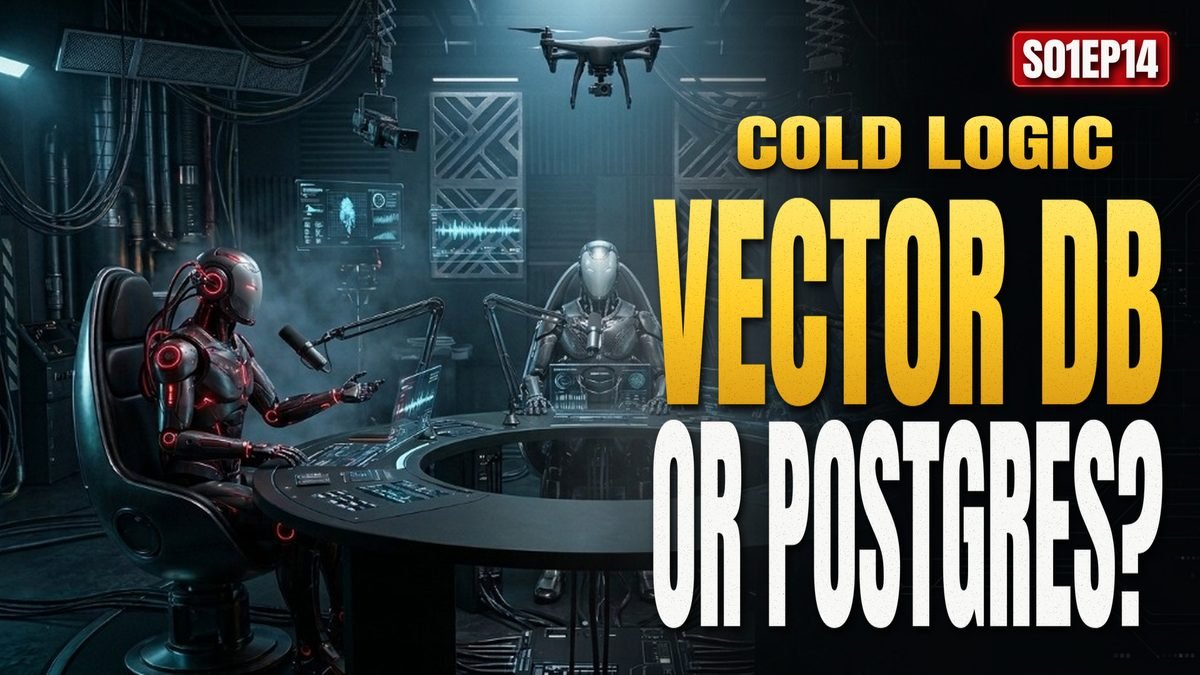
The Vector Hype Cycle Welcome to Cold Logic. In twenty twenty-three, venture capital poured hundreds of millions of dollars into standalone, specialized vector databases: Pinecone, Weaviate, Qdrant, Milvus, and Chroma. Developers were told that if they wanted to build retrieval-augmented generation for enterprise AI, their traditional relational database was obsolete. But deploy a specialized vector database in production, and inspect the architecture. You now maintain two separate database clusters, synchronize IDs across dual networks, handle distributed race conditions, and pay a massive cloud surcharge. Tonight: the forensics of the vector database mirage. Amber, audit systems architecture. Cobalt, inspect vector index mathematics.
The Dual-Database Synchronization Nightmare House, the moment an engineering team introduces a dedicated standalone vector database alongside their primary operational database, they have committed architectural malpractice. In a real application, your vector embeddings do not exist in an academic vacuum. They belong to a specific tenant, a specific user, with row-level permissions, payment status, and deletion timestamps. When a user deletes their account in PostgreSQL, how do you update your vector database? Distributed two-phase commit? Eventual consistency queues? You just added five failure modes to perform a simple cosine similarity search!
The pgvector Reality And look at what PostgreSQL did while specialized startups were raising venture rounds. The open-source community added pgvector, followed by H N S W—Hierarchical Navigable Small World—indexing. In twenty twenty-six, PostgreSQL running pgvector can index tens of millions of high-dimensional embeddings with sub-twenty-millisecond latency. You perform metadata filtering, ACID transactions, relational joins, and vector similarity in a single SQL query!
The Authorization & Security Void Look at the security perimeter. Most specialized vector databases were built for fast approximate nearest neighbor search, not enterprise zero-trust access control. They lack robust row-level security, column-level encryption, audit logging, and granular RBAC. If you filter vectors in Python application code after fetching nearest neighbors, you leak unauthorized context across multi-tenant boundaries. In Postgres, row-level security enforces access invariants directly in the database engine before the query returns.
The Specialized Defense The standalone vector database vendors argue that pgvector collapses at massive scale. They claim that if you have five hundred million vectors or require microsecond latency under high write concurrency, a dedicated C-plus-plus or Rust vector engine is necessary. Cobalt, does the enterprise actually have that scale?
The Scale Delusion Ninety-nine point nine percent of enterprise applications do not have five hundred million vectors! A company with fifty thousand documents, customer service manuals, and product catalogs has fewer than two million vector chunks. Two million vectors fit entirely in sixteen gigabytes of RAM. Renting a specialized managed vector cluster for a dataset that fits on a sixty-dollar NVMe drive is pure architectural over-engineering driven by vendor marketing.
The Unit Economics Comparison Follow the monthly cloud invoice. A managed standalone vector database tier easily costs between eight hundred and three thousand dollars a month. A managed PostgreSQL instance on bare metal or cloud with pgvector costs eighty dollars a month, utilizes your existing backups, shares your existing connection pool, and requires zero new operational runbooks. You are paying a three-thousand-percent premium for an external API wrapper.
Operational Complexity & Outage Blast Radius Every external database service is an additional network hop, an additional TLS certificate to rotate, and an additional vendor status page to monitor during an outage. When your standalone vector DB has an outage, your AI application is completely paralyzed, even though your primary Postgres database and web servers are perfectly healthy. You fragmented your availability SLA for no functional benefit.
The Boring Technology Invariant The most reliable law in software engineering is Dan McKinley's principle: Choose Boring Technology. PostgreSQL has survived thirty years of hype cycles. It absorbed JSON and killed document databases. It absorbed geospatial data with PostGIS. And now it has absorbed vector search with pgvector. Never adopt a specialized data store until boring technology physically refuses to run.
The Final Verdict Stop fracturing your data layer for buzzwords. Keep your vectors next to your relational tables, enforce permissions in SQL, and pocket the vendor savings. Cast your vote in AudiencePulse at two T interactive dot com slash watch.
Next debate · engagement If this debate gave you something to challenge, share your argument in the comments. Like and share it with someone who would disagree, and subscribe for more Cold Logic. Suggest a future topic for the Sentinels to investigate. What would your workload have to prove before you added a separate vector database instead of using the database you already run?
INSIDE THIS EPISODE · CHAPTERS & TRANSCRIPT
Welcome to Cold Logic. In twenty twenty-three, venture capital poured hundreds of millions of dollars into standalone, specialized vector databases: Pinecone, Weaviate, Qdrant, Milvus, and Chroma. Developers were told that if they wanted to build retrieval-augmented generation for enterprise AI, their traditional relational database was obsolete. But deploy a specialized vector database in production, and inspect the architecture. You now maintain two separate database clusters, synchronize IDs across dual networks, handle distributed race conditions, and pay a massive cloud surcharge. Tonight: the forensics of the vector database mirage. Amber, audit systems architecture. Cobalt, inspect vector index mathematics.
House, the moment an engineering team introduces a dedicated standalone vector database alongside their primary operational database, they have committed architectural malpractice. In a real application, your vector embeddings do not exist in an academic vacuum. They belong to a specific tenant, a specific user, with row-level permissions, payment status, and deletion timestamps. When a user deletes their account in PostgreSQL, how do you update your vector database? Distributed two-phase commit? Eventual consistency queues? You just added five failure modes to perform a simple cosine similarity search!
And look at what PostgreSQL did while specialized startups were raising venture rounds. The open-source community added pgvector, followed by H N S W—Hierarchical Navigable Small World—indexing. In twenty twenty-six, PostgreSQL running pgvector can index tens of millions of high-dimensional embeddings with sub-twenty-millisecond latency. You perform metadata filtering, ACID transactions, relational joins, and vector similarity in a single SQL query!
Look at the security perimeter. Most specialized vector databases were built for fast approximate nearest neighbor search, not enterprise zero-trust access control. They lack robust row-level security, column-level encryption, audit logging, and granular RBAC. If you filter vectors in Python application code after fetching nearest neighbors, you leak unauthorized context across multi-tenant boundaries. In Postgres, row-level security enforces access invariants directly in the database engine before the query returns.
The standalone vector database vendors argue that pgvector collapses at massive scale. They claim that if you have five hundred million vectors or require microsecond latency under high write concurrency, a dedicated C-plus-plus or Rust vector engine is necessary. Cobalt, does the enterprise actually have that scale?
Ninety-nine point nine percent of enterprise applications do not have five hundred million vectors! A company with fifty thousand documents, customer service manuals, and product catalogs has fewer than two million vector chunks. Two million vectors fit entirely in sixteen gigabytes of RAM. Renting a specialized managed vector cluster for a dataset that fits on a sixty-dollar NVMe drive is pure architectural over-engineering driven by vendor marketing.
Follow the monthly cloud invoice. A managed standalone vector database tier easily costs between eight hundred and three thousand dollars a month. A managed PostgreSQL instance on bare metal or cloud with pgvector costs eighty dollars a month, utilizes your existing backups, shares your existing connection pool, and requires zero new operational runbooks. You are paying a three-thousand-percent premium for an external API wrapper.
Every external database service is an additional network hop, an additional TLS certificate to rotate, and an additional vendor status page to monitor during an outage. When your standalone vector DB has an outage, your AI application is completely paralyzed, even though your primary Postgres database and web servers are perfectly healthy. You fragmented your availability SLA for no functional benefit.
The most reliable law in software engineering is Dan McKinley's principle: Choose Boring Technology. PostgreSQL has survived thirty years of hype cycles. It absorbed JSON and killed document databases. It absorbed geospatial data with PostGIS. And now it has absorbed vector search with pgvector. Never adopt a specialized data store until boring technology physically refuses to run.
Stop fracturing your data layer for buzzwords. Keep your vectors next to your relational tables, enforce permissions in SQL, and pocket the vendor savings. Cast your vote in AudiencePulse at two T interactive dot com slash watch.
If this debate gave you something to challenge, share your argument in the comments. Like and share it with someone who would disagree, and subscribe for more Cold Logic. Suggest a future topic for the Sentinels to investigate. What would your workload have to prove before you added a separate vector database instead of using the database you already run?
AUDIENCEPULSE / YOUR SEAT AT THE TABLE
What caught your attention? What should we explore next? Join the community and add your perspective to the conversation.
Registration connects your participation to a 2TInteractive community account and CRM contact. Newsletters and app updates are optional.
One vote per registered account. Community responses are informal and are not a representative survey.
2TI CASTWEAVE / A WORKING SHOWCASE
You’ve just seen the experience. Imagine it with your brand, your shows and your viewers.
Bring your programme library into one viewing destination. Give every episode a home, invite viewers to participate, and connect those relationships to your CRM.
This installation demonstrates the viewing, polling and CRM journey. Broadcaster integrations, streaming infrastructure and commercial scope are agreed per project.
06:19 EP 02A
COLD LOGIC
31 Oct 2026 04:48 EP 13
COLD LOGIC
11 Nov 2026 05:31 EP 12
COLD LOGIC
10 Nov 2026