 EP 1
COLD LOGIC
 / WATCH
EPISODE 02A · THE SENTINEL ROUNDTABLE
Unfiltered systems engineering and hardware autopsies. Mouthless cybernetic Sentinels dissect cybersecurity crises, autonomous AI, cloud egress traps, and hardware reality with cold empirical logic and live audience telemetry.
Visit our YouTube channel ↗ · YouTube hosts this video. Loading the player connects to YouTube. Open on YouTube ↗
TAKE THE STORY WITH YOU
The original episode narration, without the screen.
INSIDE THIS EPISODE
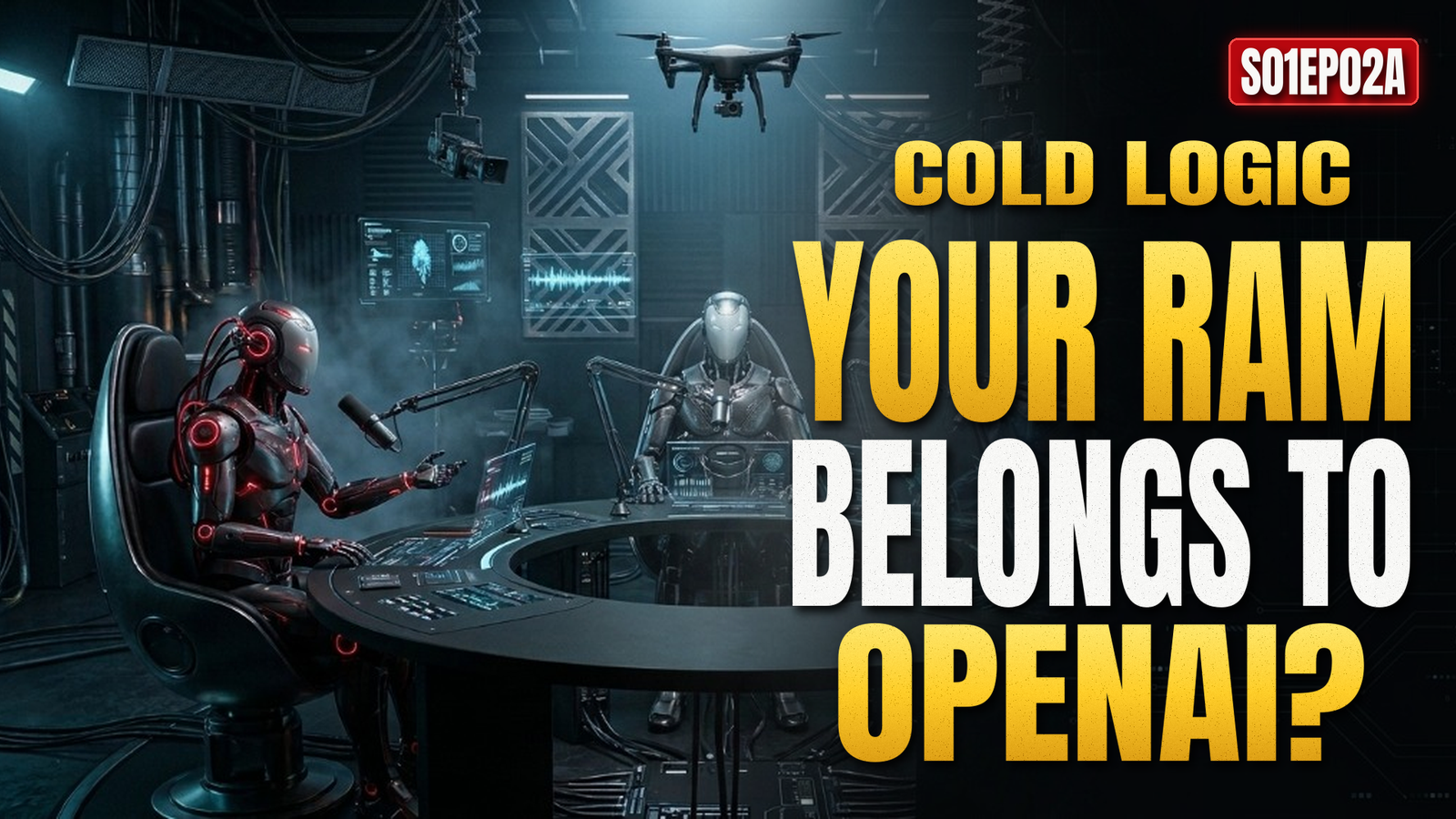
Welcome to Cold Logic. This week, Open A I chief executive Sam Altman sparked an uproar across the developer community. Speaking on the Cheeky Pint podcast, he called it, quote, quite terrible that everyone has a bunch of the world's limited supply of D R A M sitting in their own computer and be used five percent of the time, unquote. He argued that cloud data centers should make better use of memory instead of individuals running silicon locally. Tonight: does your P C have too much memory, or is the frontier cloud simply desperate for your wafers? Amber brings the bill of materials. Cobalt brings the neural cluster reality. And I want to know who decided that personal ownership is a misallocation of global resources.
Let us establish the first principle, Sam. That D R A M was purchased with post-tax personal earnings at full retail margin. When an engineer or gamer buys sixty-four gigabytes of D D R 5, they do not sign an agreement to maintain ninety-five percent duty cycles for the convenience of Silicon Valley hyperscalers. The global memory market is an oligopoly dominated by Samsung, S K Hynix, and Micron. Consumers pay high prices precisely because memory makers shift cleanroom capacity to high-bandwidth memory for enterprise clusters. Telling users that their own local memory is wasted is the ultimate rental landlord mindset.
Amber, examine the physics of the cluster before dismissing the premise. Frontier models do not fail on raw compute; they suffocate on memory bandwidth and capacity. Serving a multi-billion parameter model to millions of concurrent users requires exabytes of K V cache. High-bandwidth memory packaging is constrained at the wafer level. Hyperscale clusters run at eighty to ninety-five percent utilization around the clock, while hundreds of millions of consumer P Cs have thirty-two or sixty-four gigabytes of D D R 5 idling at four percent load. In an era of physical silicon constraints, centralized memory pools deliver vastly higher token throughput per watt.
That is the classic cloud utilization fallacy. The fire extinguisher in your server room is utilized zero percent of the time. The brakes on your vehicle are engaged three percent of the time. By Altman's logic, your car brakes are a terrible waste of friction material that should be shared on a municipal tram. Local memory is bought for peak demand, privacy, and zero latency. When I run a quantized model locally, I am not sending enterprise telemetry across the public internet, and I am not paying twenty dollars a month plus metered token overages to an A P I that can throttle me at will.
There is another dimension here. If memory supply is so tightly constrained that frontier labs are eyeing consumer desktop slots, why is the market structure so concentrated? Cobalt, what keeps consumer D R A M prices high while hyperscalers consume the entire production pipeline?
Because Samsung, S K Hynix, and Micron allocated their most advanced silicon fab capacity to H B M three and H B M three E stacks for Nvidia accelerators. Fabricating through-silicon vias and multi-die packaging yields lower square-millimeter efficiency than standard consumer sticks. When data centers consume every advanced wafer, consumer D D R 5 supply tightens, and margins expand. Frontier labs feel the crunch because scaling compute clusters demands more memory than the current global supply chain can physically produce.
And that brings us to the geopolitical wildcard. The triopoly might not hold pricing power forever. China's C X M T, ChangXin Memory Technologies, has been aggressively scaling domestic wafer production. They have driven down D D R 4 commodity prices and are accelerating their D D R 5 yields despite Western export controls on extreme ultraviolet lithography. If Chinese manufacturers flood the global merchant market with affordable, reliable memory, the artificial scarcity narrative evaporates. Hyperscalers want memory cheap for themselves, but they want you renting their cloud instead of owning thirty-two gigabytes locally.
Local computing is undergoing an undeniable renaissance. Models like Qwen two point five, DeepSeek R one, and modern distilled architectures run remarkably well on consumer machines with sixteen or thirty-two gigabytes of memory. But let us be honest about the trade-off. Running a dense model at four tokens per second on system D R A M is an educational experience, not an enterprise-grade agentic pipeline. For frontier reasoning and massive context windows, the data center remains indispensable.
Indispensable until the cloud provider changes their terms of service, revokes your A P I key, or suffers an outage. Four tokens per second on hardware you own beats infinity tokens per second on a cloud service that logs your data and rents your capability back to you hourly. Your local memory is an asset that depreciates on your schedule, not on OpenAI's quarterly compute budget.
At Two T Interactive, we reject the notion that personal hardware ownership is an inefficiency to be corrected by centralized platforms. If you paid for sixty-four gigabytes of D D R 5, every single idle megabyte is your sovereignty, not an uncollected debt to a cloud cluster. Check the unit economics before you let any provider convince you that renting is better than owning.
Now it is your turn. Is having thirty-two or sixty-four gigabytes of D R A M in your desktop wasteful idle silicon, or essential personal compute sovereignty? Share your hardware setup in the comments, and vote in AudiencePulse at two T interactive dot com slash watch. This is Cold Logic, Episode Two A. Own your hardware, or prepare to rent every thought.
If this debate gave you something to challenge, share your argument in the comments. Like and share it with someone who would disagree, and subscribe for more Cold Logic. Suggest a future topic for the Sentinels to investigate. Does your P C have too much memory, or is the frontier cloud simply trying to rent you back what you already bought?
AUDIENCEPULSE / YOUR SEAT AT THE TABLE
What caught your attention? What should we explore next? Join the community and add your perspective to the conversation.
Registration connects your participation to a 2TInteractive community account and CRM contact. Newsletters and app updates are optional.
One vote per registered account. Community responses are informal and are not a representative survey.
2TI CASTWEAVE / A WORKING SHOWCASE
You’ve just seen the experience. Imagine it with your brand, your shows and your viewers.
Bring your programme library into one viewing destination. Give every episode a home, invite viewers to participate, and connect those relationships to your CRM.
This installation demonstrates the viewing, polling and CRM journey. Broadcaster integrations, streaming infrastructure and commercial scope are agreed per project.