
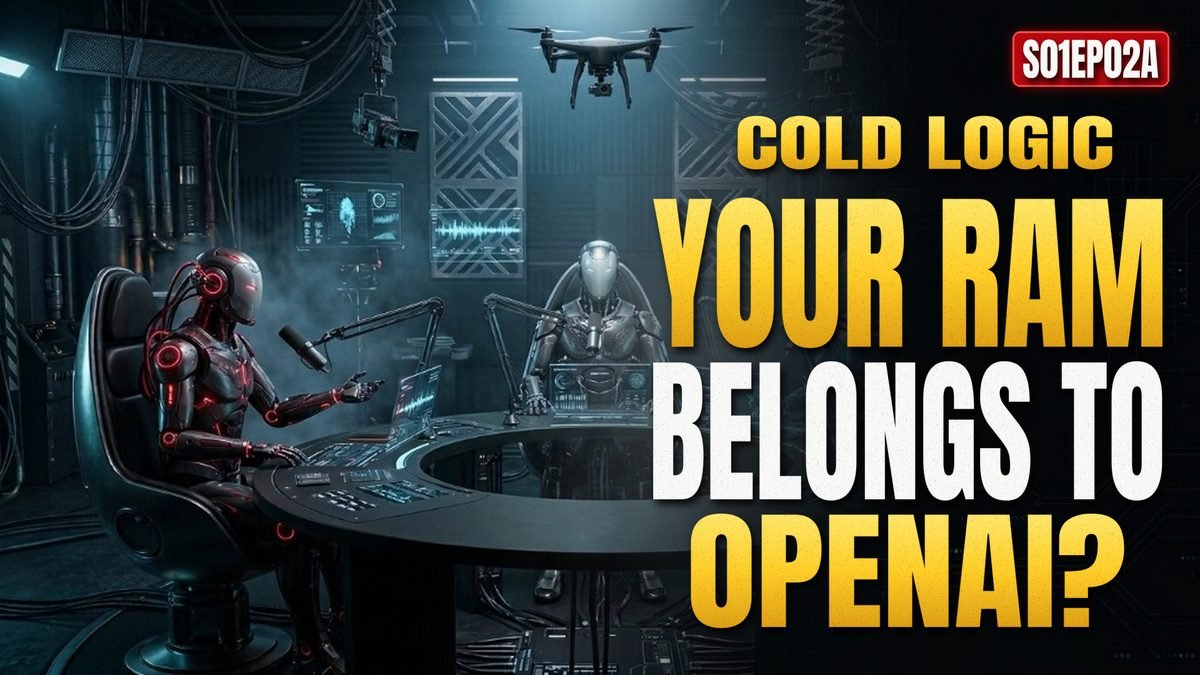
 06:19 EP 02A
COLD LOGIC
31 Oct 2026“Quite Terrible”: Why OpenAI Thinks Your PC Has Too Much RAM
🎧 Audio 📝 Rundown ? Poll
Watch episode
 / WATCH
EPISODE 11 · 2TINTERACTIVE ORIGINAL
What is the biggest point of failure in most home self-hosting setups?
Visit our YouTube channel ↗ · YouTube hosts this video. Loading the player connects to YouTube. Open on YouTube ↗
TAKE THE STORY WITH YOU
The original episode narration, without the screen.
READ ALONG
The Homelab Sovereign Illusion Welcome to Cold Logic. Across the internet, engineers spend thousands of dollars on enterprise server racks, noisy noctua fans, unRAID clusters, and colorful dashboard metrics. They proudly post photos of their basements captioned: 'Finally achieved total cloud independence.' But look past the blue LEDs. Their traffic routes through Cloudflare tunnels, their dynamic DNS depends on a closed registrar, their ISP throttles residential ports, and their backups live on a single USB drive. Tonight: the forensics of self-hosting vanity metrics. Emerald, define sovereign reality. Amber, audit the hardware cost.
Sovereignty vs Homelab Toys House, sovereignty is not owning a piece of metal under your desk. Sovereignty is the ability to operate autonomously when upstream infrastructure cuts you off. If your self-hosted stack goes dark the moment Cloudflare updates its terms of service or your residential internet provider blocks port eighty, you are not sovereign. You are merely hosting upstream corporate dependencies on expensive, unbacked consumer silicon.
The Balance Sheet Audit Audit the balance sheet of the typical homelab warrior. Four thousand dollars in enterprise refurbished Xeon servers that idle at three hundred watts. Two hundred dollars a month in residential electrical bills. Fifty hours a month debugging Docker Compose YAML files, broken updates, and ZFS pool errors. And what is running on this four-thousand-dollar cathedral? A media streaming server, a password manager, and an idle Ollama instance. You have become an unpaid tier-one sysadmin for your own living room.
The Residential Attack Surface And look at the security disaster. In an enterprise datacenter, you have hardware firewalls, physical access controls, continuous vulnerability scans, and off-site immutable air-gapped backups. In a residential homelab, you have an unpatched consumer router with open port forwarding, IoT smart bulbs sharing the same local subnet, and zero intrusion detection. The average homelab is not a digital fortress; it is an open staging ground for botnet operators.
The Tunnel Dependency The standard community advice for avoiding open ports is to run Cloudflare Zero Trust tunnels or Tailscale. Emerald, does tunneling to a commercial proxy preserve sovereignty?
The MitM Chokepoint It completely destroys it! When you route your home server through a Cloudflare tunnel, Cloudflare terminates TLS at their edge. They inspect every plaintext packet, log every IP header, and hold the cryptographic authority to terminate your traffic with a single automated policy flag. You did not escape the cloud chokepoint; you willingly handed them an unencrypted tap into your home network.
The Disaster Recovery Lie Ask any self-hosting enthusiast about their disaster recovery plan. What happens when a water pipe bursts above the server rack? What happens when a lightning strike surges past your consumer UPS? What happens when you suffer a silent ZFS controller failure? True sovereignty requires geographic dispersion, automated clean-room restores, and air-gapped cold replication. If your data only exists in one physical room, you don't have backups; you have temporary luck.
The Unpaid Maintenance Debt Software does not remain stable in a vacuum. Libraries deprecate, certificate authorities expire, security patches emerge every Tuesday. The moment the homelab owner goes on vacation or gets sick, the stack begins to decay. A sovereign system must maintain itself through automated deterministic orchestration, not fragile late-night manual tinkering.
True Digital Sovereignty Architecture Real digital sovereignty is boring, resilient, and minimal. It is local-first data stored in open, unencrypted file formats. It is peer-to-peer cryptographic replication over WireGuard. It is cold, air-gapped optical or magnetic backups stored in multiple physical jurisdictions. And it requires zero proprietary web tunnels or corporate proxy accounts to function.
The Final Verdict Buying hardware is easy; building sovereign resilience is hard. A loud server rack in your bedroom does not make you independent if your network umbilical cord still runs through Big Tech chokepoints. Stop measuring sovereignty in terabytes and dashboard widgets. Measure it in survival. Vote in AudiencePulse at two T interactive dot com slash watch.
Next debate · engagement If this debate gave you something to challenge, share your argument in the comments. Like and share it with someone who would disagree, and subscribe for more Cold Logic. Suggest a future topic for the Sentinels to investigate. If your internet connection or favorite provider disappeared tomorrow, which part of your self-hosted setup would still work?
INSIDE THIS EPISODE · CHAPTERS & TRANSCRIPT
Welcome to Cold Logic. Across the internet, engineers spend thousands of dollars on enterprise server racks, noisy noctua fans, unRAID clusters, and colorful dashboard metrics. They proudly post photos of their basements captioned: 'Finally achieved total cloud independence.' But look past the blue LEDs. Their traffic routes through Cloudflare tunnels, their dynamic DNS depends on a closed registrar, their ISP throttles residential ports, and their backups live on a single USB drive. Tonight: the forensics of self-hosting vanity metrics. Emerald, define sovereign reality. Amber, audit the hardware cost.
House, sovereignty is not owning a piece of metal under your desk. Sovereignty is the ability to operate autonomously when upstream infrastructure cuts you off. If your self-hosted stack goes dark the moment Cloudflare updates its terms of service or your residential internet provider blocks port eighty, you are not sovereign. You are merely hosting upstream corporate dependencies on expensive, unbacked consumer silicon.
Audit the balance sheet of the typical homelab warrior. Four thousand dollars in enterprise refurbished Xeon servers that idle at three hundred watts. Two hundred dollars a month in residential electrical bills. Fifty hours a month debugging Docker Compose YAML files, broken updates, and ZFS pool errors. And what is running on this four-thousand-dollar cathedral? A media streaming server, a password manager, and an idle Ollama instance. You have become an unpaid tier-one sysadmin for your own living room.
And look at the security disaster. In an enterprise datacenter, you have hardware firewalls, physical access controls, continuous vulnerability scans, and off-site immutable air-gapped backups. In a residential homelab, you have an unpatched consumer router with open port forwarding, IoT smart bulbs sharing the same local subnet, and zero intrusion detection. The average homelab is not a digital fortress; it is an open staging ground for botnet operators.
The standard community advice for avoiding open ports is to run Cloudflare Zero Trust tunnels or Tailscale. Emerald, does tunneling to a commercial proxy preserve sovereignty?
It completely destroys it! When you route your home server through a Cloudflare tunnel, Cloudflare terminates TLS at their edge. They inspect every plaintext packet, log every IP header, and hold the cryptographic authority to terminate your traffic with a single automated policy flag. You did not escape the cloud chokepoint; you willingly handed them an unencrypted tap into your home network.
Ask any self-hosting enthusiast about their disaster recovery plan. What happens when a water pipe bursts above the server rack? What happens when a lightning strike surges past your consumer UPS? What happens when you suffer a silent ZFS controller failure? True sovereignty requires geographic dispersion, automated clean-room restores, and air-gapped cold replication. If your data only exists in one physical room, you don't have backups; you have temporary luck.
Software does not remain stable in a vacuum. Libraries deprecate, certificate authorities expire, security patches emerge every Tuesday. The moment the homelab owner goes on vacation or gets sick, the stack begins to decay. A sovereign system must maintain itself through automated deterministic orchestration, not fragile late-night manual tinkering.
Real digital sovereignty is boring, resilient, and minimal. It is local-first data stored in open, unencrypted file formats. It is peer-to-peer cryptographic replication over WireGuard. It is cold, air-gapped optical or magnetic backups stored in multiple physical jurisdictions. And it requires zero proprietary web tunnels or corporate proxy accounts to function.
Buying hardware is easy; building sovereign resilience is hard. A loud server rack in your bedroom does not make you independent if your network umbilical cord still runs through Big Tech chokepoints. Stop measuring sovereignty in terabytes and dashboard widgets. Measure it in survival. Vote in AudiencePulse at two T interactive dot com slash watch.
If this debate gave you something to challenge, share your argument in the comments. Like and share it with someone who would disagree, and subscribe for more Cold Logic. Suggest a future topic for the Sentinels to investigate. If your internet connection or favorite provider disappeared tomorrow, which part of your self-hosted setup would still work?
AUDIENCEPULSE / YOUR SEAT AT THE TABLE
What caught your attention? What should we explore next? Join the community and add your perspective to the conversation.
Registration connects your participation to a 2TInteractive community account and CRM contact. Newsletters and app updates are optional.
One vote per registered account. Community responses are informal and are not a representative survey.
2TI CASTWEAVE / A WORKING SHOWCASE
You’ve just seen the experience. Imagine it with your brand, your shows and your viewers.
Bring your programme library into one viewing destination. Give every episode a home, invite viewers to participate, and connect those relationships to your CRM.
This installation demonstrates the viewing, polling and CRM journey. Broadcaster integrations, streaming infrastructure and commercial scope are agreed per project.
06:19 EP 02A
COLD LOGIC
31 Oct 2026 04:42 EP 10
COLD LOGIC
8 Nov 2026 04:41 EP 9
COLD LOGIC
7 Nov 2026