The Great Automation Lie:
Why Your “Concierge” Bot Feels Like a Firewall to Your Customers
The Introduction:
The Broken Promise of the 24/7 Employee
We were promised a revolution.
We were told that corporate chatbots would be the ultimate digital employees, tireless, infinitely scalable, and capable of handling 80% of customer queries without breaking a sweat.
The C-suite saw a massive reduction in OpEx. Operations leaders saw the end of the support queue backlog.
So why does everyone hate them?
Why do customers immediately type “AGENT,” “HUMAN,” or smash their keyboard in frustration the moment the little chat bubble pops up?
The failure of most corporate chatbots isn’t technological; their natural language processing is better than ever. The failure is epistemological. We fundamentally misunderstood what a conversation is.
At 2tinteractive, we’ve analyzed the gap between deployed bots and customer satisfaction.
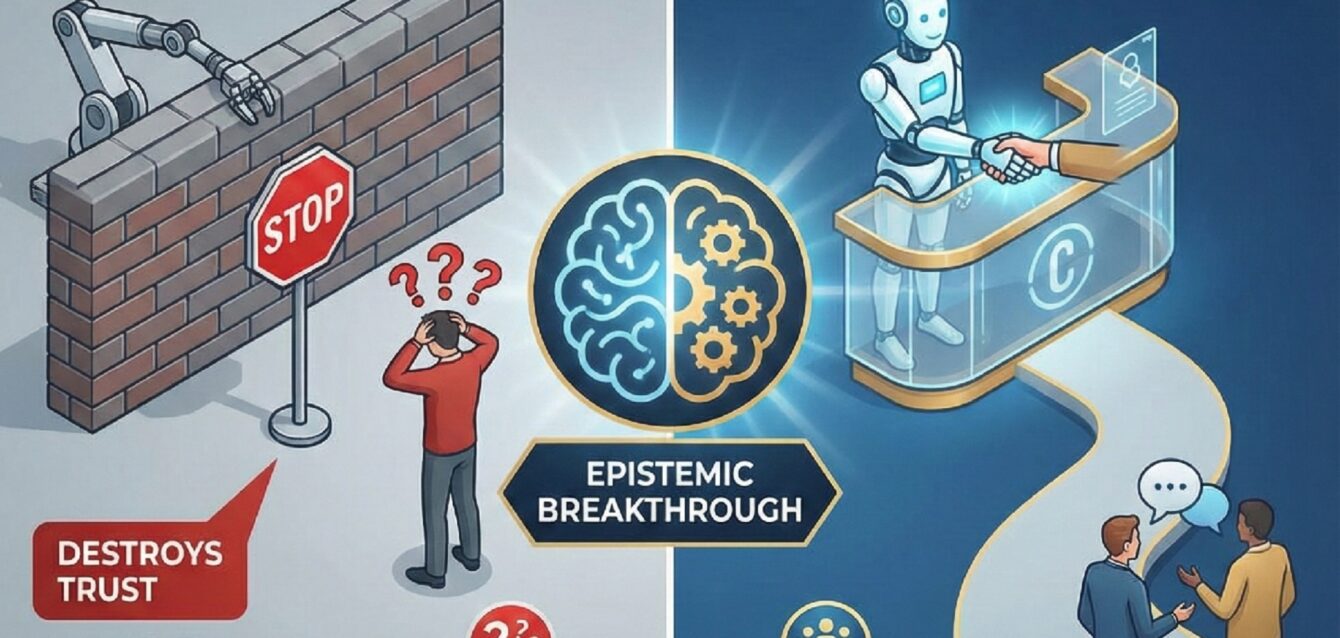
The reality is that most companies are marketing their chatbots as helpful concierges, but they have designed them as defensive firewalls.
Their primary goal isn’t to help the user enter; it’s to keep the user out of the expensive human support channel.
And your customers know it.
The Mistake: Confusing Data Transfer with Emotional Regulation
The root cause of this failure is a hidden assumption in business: We assume that customers contact support solely to exchange information.
If a customer asks, “Where is my order?”, a bot can easily provide a tracking number. That’s information exchange.
But a customer rarely just wants a tracking number. They are often anxious because the package is late for a birthday, or frustrated because this is the third delay.
When a bot delivers cold data without acknowledging the hot emotion, it fails the interaction even if the data is correct.
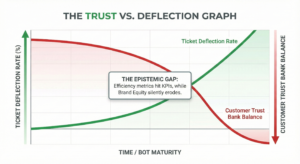
Every time your bot says, “I’m sorry, I didn’t quite catch that,” it isn’t just a technical hiccup. It is a withdrawal from the customer’s “Trust Bank Account” with your brand. When that account hits zero, they don’t just ask for a human; they start looking for a competitor.
The Shift: From “Fake Human” to “Smart Interface”
Does this mean we should scrap chatbots? absolutely not. We need them more than ever. But we need to stop asking them to pretend to be humans and start letting them be what they are: incredibly fast, high-bandwidth interfaces for data retrieval.
We need to pivot from Deflection to Triage.
At 2tinteractive, we believe the true power of automation isn’t replacing humans; it’s “clearing the runway” for humans.
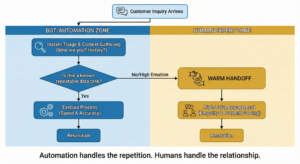
* What Bots Should Do (Low Entropy Tasks): Instant data retrieval, password resets, order status, form-filling, scheduling. These are high-speed, low-emotion tasks where humans are actually too slow.
* What Humans Must Do (High Entropy Tasks): Complex problem-solving, de-escalating anger, nuanced negotiations, providing empathy during a crisis.
When you force a human to reset a password, you are wasting intelligence. When you force a bot to handle an angry customer, you are destroying trust.
The 2tinteractive Approach: Designing for the Handshake
The future belongs to companies that master the “handshake” between silicon and carbon.
If your bot is a firewall, it’s time to tear it down. A successful automation strategy doesn’t hide your humans; it makes them more accessible when it matters most.
By leveraging bots to handle the high-volume, repetitive noise, you improve speed of access and data flow across the organization. You free your human teams from drudgery so they have the cognitive bandwidth to do what only humans can do: build trust, one complex conversation at a time.
Don’t just buy a chatbot. Design a better way for your customers to experience your brand.