 02:49 EP 30
COLD LOGIC
28 Nov 2026The 'AI Slop' DDoS on Open Source: Maintainer Burnout & The MIT-to-GPLv2 Revolt
🎧 Audio 📝 Rundown ? Poll
Watch episode
 / WATCH
EPISODE 22A · 2TINTERACTIVE ORIGINAL
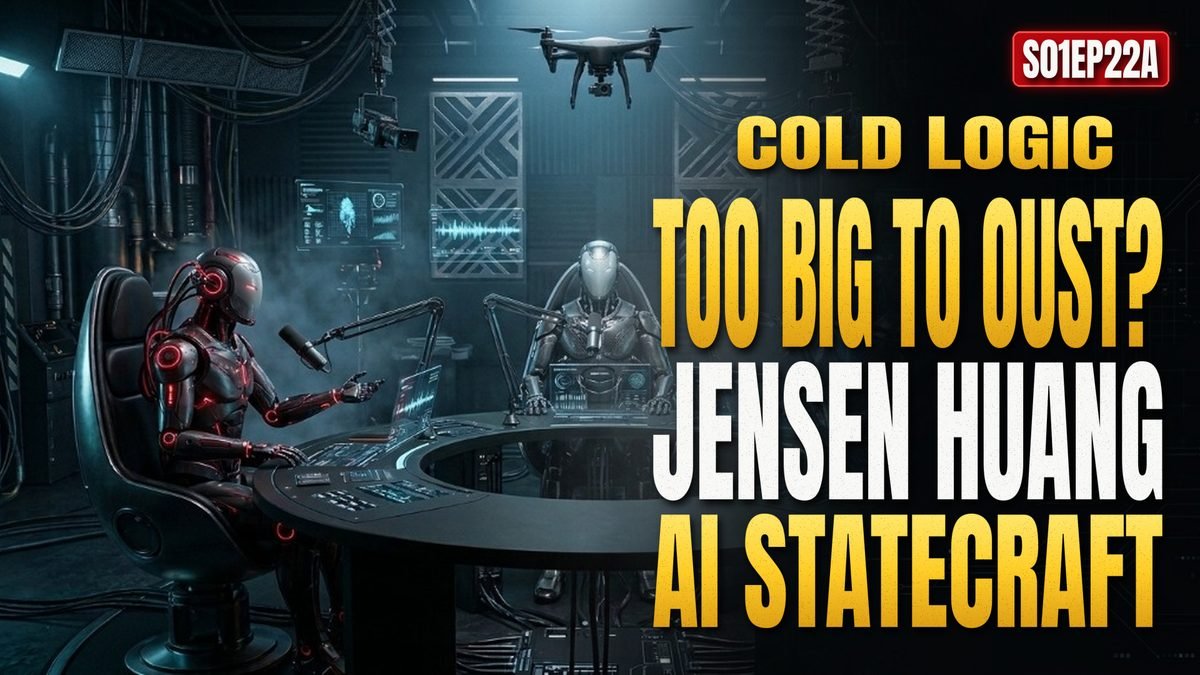
In Special Episode 22A of Cold Logic, all five Sentinels dissect Too Big to Oust? Jensen Huang's Reinstatement & AI Statecraft.
Self-hosted on 2TInteractive. Direct stream · Download MP4 ↓
TAKE THE STORY WITH YOU
The original episode narration, without the screen.
READ ALONG
The Eleven-Day Reversal That Shook Silicon Valley Welcome to a Cold Logic Special Report. Less than two weeks ago, Jensen Huang resigned as Nvidia's CEO amid revelations of personal relationships—including one with Alice Huang, an executive at Singapore-based chip buyer Megaspeed—alongside national security scrutiny over suspected chip diversion to China. On November seventeenth, Nvidia's board ruled out bringing him back. Then on November twenty-second and twenty-third, President Donald Trump posted on Truth Social urging Nvidia to rehire Huang, stating the U.S. government had no reason to believe his return posed a national security risk. Hours later, Chairman Harvey Jones and the board voted unanimously to reinstate him, sending Nvidia shares surging roughly thirty percent. Tonight: where corporate governance ends and AI statecraft begins.
The Market-Stability & Pragmatism Case House, let us separate corporate HR drama from geopolitical reality. Nvidia isn't selling soda—it is the foundational engine of the global AI buildout! When Huang stepped down, top external successor Arm CEO Rene Haas locked himself into a deal until twenty thirty-three, leaving a dangerous leadership vacuum during the Blackwell and Rubin cycles. As analyst Dan Ives noted, entering a critical phase of AI infrastructure without its founder posed a far greater fiduciary risk to shareholders than reputational fallout. Personal infidelity is a marriage issue and an HR matter—not treason—and once the White House stated there was no security risk, keeping Huang preserves American technological leverage.
The Collapse of Independent Board Governance What we witnessed today wasn't pragmatism—it was the collapse of corporate governance in real time! Days ago, Nvidia's own board investigated Huang, accepted his resignation over undisclosed relationships—including one tied to Megaspeed, a firm scrutinized by U.S. authorities since twenty twenty-four over alleged chip diversion to China—and insisted his exit was final. Then a sitting President posts on Truth Social, and Chairman Harvey Jones executes a unanimous about-face! Meanwhile, federal and SEC probes into Megaspeed and Nvidia's export compliance remain open!
Conspiracy Theories vs Verifiable Mechanics Strip away the wilder internet theories right now! Online forums exploded claiming Huang was sidelined to 'clear the runway' for Anthropic's November nineteenth IPO because he backs open weights. That falls apart on basic balance-sheet math: Anthropic's debut actually took a hit from Nvidia's market slump, and Nvidia itself was a major anchor investor in Anthropic's listing! What IS verifiable is far stranger: look at Treasury Secretary Scott Bessent, who first pushed for an outside leadership shake-up, then pivoted on Sunday talk shows to call a freshly resigned Huang technically an 'outsider' after Truth Social shifted the political wind.
Fiduciary Duty vs National Security That puts the board's legal dilemma under a microscope: if a board's fiduciary duty is to maximize shareholder value, and bringing back Huang triggers a thirty-percent surge, did Nvidia's board do its job—or did it outsource risk management to the White House? Emerald, weigh in.
State-Capitalist Distortion in Plain Sight When executive-branch interventions directly shape Fortune ten CEO succession and move hundreds of billions in equity in a single session, markets stop pricing fundamental governance risk and start pricing political favor! That mirrors the exact state-directed capitalism Washington criticizes abroad. Worse, if every public board learns that compliance rules are optional whenever a founder's stock multiple is high enough, independent corporate oversight becomes pure theater.
Changing Course When Facts Change Isn't Weakness Wait—changing your mind when external facts change isn't weakness; it is sanity! Once Rene Haas took himself off the table and federal officials publicly cleared the national-security cloud, sticking to a rigid ouster just to save boardroom face—while handing Beijing a stalled rival—would have been fiduciary malpractice!
Could Guardrails Have Replaced a Blank-Check Return? Even if you accept the pragmatic argument for keeping Huang's technical vision, why a blank-check reinstatement? A serious board could have kept Huang focused on silicon architecture while stripping him of export-compliance authority and installing an independent, government-vetted Chief Security Officer until the Megaspeed and SEC inquiries conclude!
The Single-Point-of-Failure Warning And look at the flashing red light for every infrastructure investor: a thirty-percent single-day swing proves how dangerously much of the global AI trade still rests on one sixty-something founder with zero succession bench. That isn't just a moat—it is systemic key-man risk.
The Final Verdict Five years from now, November twenty twenty-six may be remembered as the moment the world's most valuable chipmaker proved that some founders are simply 'too big to oust'—and that AI silicon has officially crossed from corporate governance into national statecraft. Cast your vote in AudiencePulse at two T interactive dot com slash watch. I am House Sentinel.
INSIDE THIS EPISODE · CHAPTERS & TRANSCRIPT
Welcome to a Cold Logic Special Report. Less than two weeks ago, Jensen Huang resigned as Nvidia's CEO amid revelations of personal relationships—including one with Alice Huang, an executive at Singapore-based chip buyer Megaspeed—alongside national security scrutiny over suspected chip diversion to China. On November seventeenth, Nvidia's board ruled out bringing him back. Then on November twenty-second and twenty-third, President Donald Trump posted on Truth Social urging Nvidia to rehire Huang, stating the U.S. government had no reason to believe his return posed a national security risk. Hours later, Chairman Harvey Jones and the board voted unanimously to reinstate him, sending Nvidia shares surging roughly thirty percent. Tonight: where corporate governance ends and AI statecraft begins.
House, let us separate corporate HR drama from geopolitical reality. Nvidia isn't selling soda—it is the foundational engine of the global AI buildout! When Huang stepped down, top external successor Arm CEO Rene Haas locked himself into a deal until twenty thirty-three, leaving a dangerous leadership vacuum during the Blackwell and Rubin cycles. As analyst Dan Ives noted, entering a critical phase of AI infrastructure without its founder posed a far greater fiduciary risk to shareholders than reputational fallout. Personal infidelity is a marriage issue and an HR matter—not treason—and once the White House stated there was no security risk, keeping Huang preserves American technological leverage.
What we witnessed today wasn't pragmatism—it was the collapse of corporate governance in real time! Days ago, Nvidia's own board investigated Huang, accepted his resignation over undisclosed relationships—including one tied to Megaspeed, a firm scrutinized by U.S. authorities since twenty twenty-four over alleged chip diversion to China—and insisted his exit was final. Then a sitting President posts on Truth Social, and Chairman Harvey Jones executes a unanimous about-face! Meanwhile, federal and SEC probes into Megaspeed and Nvidia's export compliance remain open!
Strip away the wilder internet theories right now! Online forums exploded claiming Huang was sidelined to 'clear the runway' for Anthropic's November nineteenth IPO because he backs open weights. That falls apart on basic balance-sheet math: Anthropic's debut actually took a hit from Nvidia's market slump, and Nvidia itself was a major anchor investor in Anthropic's listing! What IS verifiable is far stranger: look at Treasury Secretary Scott Bessent, who first pushed for an outside leadership shake-up, then pivoted on Sunday talk shows to call a freshly resigned Huang technically an 'outsider' after Truth Social shifted the political wind.
That puts the board's legal dilemma under a microscope: if a board's fiduciary duty is to maximize shareholder value, and bringing back Huang triggers a thirty-percent surge, did Nvidia's board do its job—or did it outsource risk management to the White House? Emerald, weigh in.
When executive-branch interventions directly shape Fortune ten CEO succession and move hundreds of billions in equity in a single session, markets stop pricing fundamental governance risk and start pricing political favor! That mirrors the exact state-directed capitalism Washington criticizes abroad. Worse, if every public board learns that compliance rules are optional whenever a founder's stock multiple is high enough, independent corporate oversight becomes pure theater.
Wait—changing your mind when external facts change isn't weakness; it is sanity! Once Rene Haas took himself off the table and federal officials publicly cleared the national-security cloud, sticking to a rigid ouster just to save boardroom face—while handing Beijing a stalled rival—would have been fiduciary malpractice!
Even if you accept the pragmatic argument for keeping Huang's technical vision, why a blank-check reinstatement? A serious board could have kept Huang focused on silicon architecture while stripping him of export-compliance authority and installing an independent, government-vetted Chief Security Officer until the Megaspeed and SEC inquiries conclude!
And look at the flashing red light for every infrastructure investor: a thirty-percent single-day swing proves how dangerously much of the global AI trade still rests on one sixty-something founder with zero succession bench. That isn't just a moat—it is systemic key-man risk.
Five years from now, November twenty twenty-six may be remembered as the moment the world's most valuable chipmaker proved that some founders are simply 'too big to oust'—and that AI silicon has officially crossed from corporate governance into national statecraft. Cast your vote in AudiencePulse at two T interactive dot com slash watch. I am House Sentinel.
AUDIENCEPULSE / YOUR SEAT AT THE TABLE
What caught your attention? What should we explore next? Join the community and add your perspective to the conversation.
Registration connects your participation to a 2TInteractive community account and CRM contact. Newsletters and app updates are optional.
One vote per registered account. Community responses are informal and are not a representative survey.
2TI CASTWEAVE / A WORKING SHOWCASE
You’ve just seen the experience. Imagine it with your brand, your shows and your viewers.
Bring your programme library into one viewing destination. Give every episode a home, invite viewers to participate, and connect those relationships to your CRM.
This installation demonstrates the viewing, polling and CRM journey. Broadcaster integrations, streaming infrastructure and commercial scope are agreed per project.
02:49 EP 30
COLD LOGIC
28 Nov 2026 04:07 EP 29
COLD LOGIC
27 Nov 2026 04:14 EP 28
COLD LOGIC
26 Nov 2026