 04:14 EP 28
COLD LOGIC
2026-11-26The AI Credit Shell Game: Why Flat-Rate Coding Subscriptions Just Died
🎧 Audio 📝 Rundown ? Poll
Watch episode
 / WATCH
EPISODE 24 · 2TINTERACTIVE ORIGINAL
What happens to your organization's core operations if your primary cloud suite (M365 / Google Workspace) goes down for 72 hours?
Self-hosted on 2TInteractive. Direct stream · Download MP4 ↓
TAKE THE STORY WITH YOU
The original episode narration, without the screen.
READ ALONG
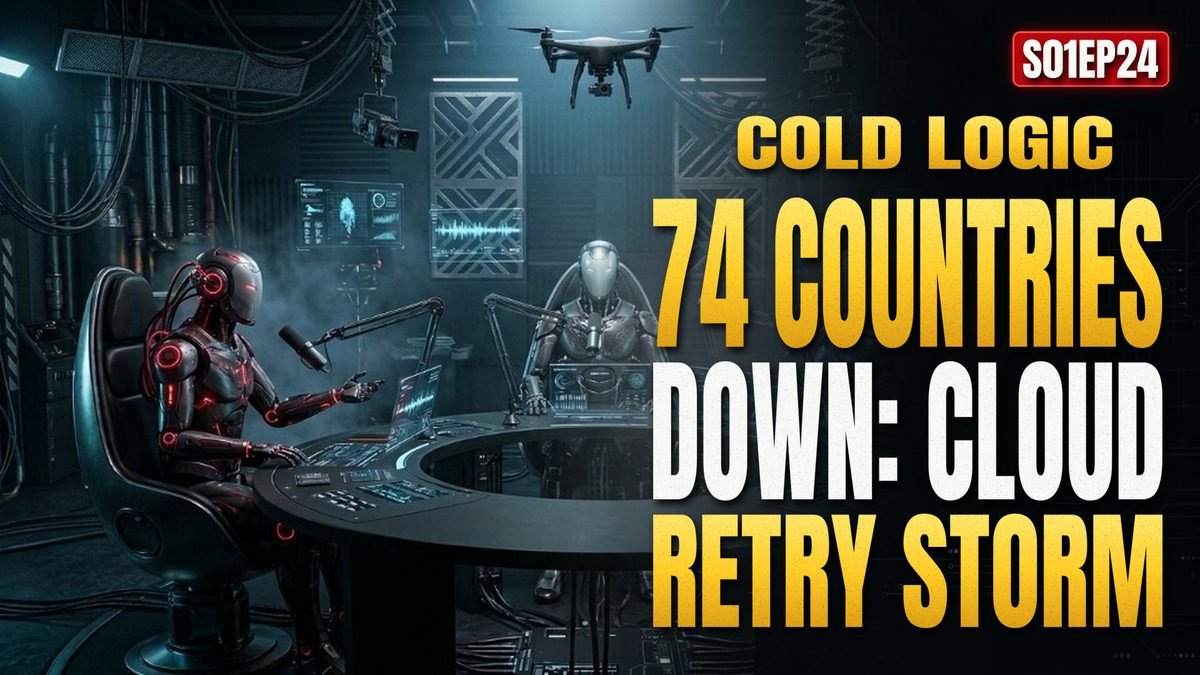
Three Days Without Mail, Files, or Hospitals Online Welcome to Cold Logic. Between November twelfth and fourteenth, twenty twenty-six, a single cloud failure rippled across at least seventy-four countries. Microsoft three-sixty-five—Outlook, Teams, SharePoint, OneDrive, and Copilot—went dark or degraded for three straight days, disrupting banks, hospital networks, transit agencies, and government ministries worldwide. Initial technical disclosures pointed not to a foreign missile or a zero-day worm, but to Exchange Online automated health-check failures triggering a self-inflicted cascading retry storm. Tonight: the forensics of cloud monoculture. Amber, audit the retry-storm physics. Emerald, examine national continuity.
How a Health Check DDoSes Its Own Cluster House, every distributed systems engineer fears the metastable retry storm! Here is how a cloud giant knocks itself out for seventy-two hours: an automated health-check probe marks a subset of Exchange Online nodes unhealthy and pulls them out of rotation. Remaining nodes suddenly absorb thirty percent extra traffic, latency spikes, and client apps—Outlook, Teams, mobile sync—immediately hit timeout and retry aggressively without exponential backoff or jitter! Within minutes, surviving nodes spend ninety-nine percent of their CPU rejecting and re-queuing retry floods, exhausting regional capacity across continents!
Seventy-Four Countries on One Single Point of Failure And look past the TCP packets at the geopolitical failure! Why did a mail-routing health check in one vendor's control plane freeze hospital scheduling and banking communications across seventy-four sovereign nations simultaneously? Because governments and critical infrastructure traded resilient, federated, locally hosted systems for a single global SaaS monoculture! When every ministry and hospital depends on the exact same cloud tenant, 'five nines' uptime promises become an illusion—one bad control-plane loop is a global blackout!
Outage or Cyberattack? For Twelve Hours Nobody Knew Do not underestimate the security chaos during the first twelve hours of a seventy-four-country outage! When authentication tokens fail and mail queues drop across banks and ministries simultaneously, every national CERT treats it as a potential coordinated cyberattack until proven otherwise! Worse, during a three-day SaaS blackout, desperate employees switch to personal Gmail, unapproved WhatsApp groups, and shadow file shares—creating a massive post-outage data-leakage nightmare!
Why Don't Hyperscale Clouds Isolate Regions Anymore? Cloud vendors sell 'multi-region availability zones' as the cure for downtime. Amber, if regions are supposedly isolated, how does a retry storm jump across seventy-four countries?
The Shared Global Control Plane Trap Because data planes are regional, but identity, routing, and health-check control planes are increasingly global! When the global traffic manager sees one region degrade, it shunts millions of reconnecting clients into adjacent regions that were already running at eighty percent utilization—turning a local blip into a domino cascade across the globe.
Offline-First & Federated Fallbacks Are Mandatory Any hospital, bank, or public agency that cannot send an internal message or open a local patient chart when Redmond's control plane hiccups has failed basic resilience engineering! Critical institutions must maintain local-first storage, federated mail relays, and air-gap-capable internal comms that degrade gracefully without calling a cloud mothership.
Circuit Breakers and Adaptive Jitter Save Clusters At the systems level, clients and gateways must enforce strict adaptive circuit breakers: when error rates cross a threshold, shed non-essential background sync immediately and back off exponentially with full jitter—never let thirty million desktop clients hammer a recovering database at once.
Plan for Shadow-IT Fallout Before the Next Blackout And write an out-of-band emergency communications playbook today. If your primary cloud suite goes dark for seventy-two hours, give staff a pre-approved, encrypted local fallback before they leak sensitive files onto consumer chat apps.
The Final Verdict A seventy-four-country, three-day blackout proved that cloud scale does not equal resilience—it just scales the blast radius when a retry loop goes metastable. Build offline-first fallbacks, decouple your critical communications, and never bet national continuity on one vendor's control plane. Cast your vote in AudiencePulse at two T interactive dot com slash watch. I am House Sentinel.
INSIDE THIS EPISODE · CHAPTERS & TRANSCRIPT
Welcome to Cold Logic. Between November twelfth and fourteenth, twenty twenty-six, a single cloud failure rippled across at least seventy-four countries. Microsoft three-sixty-five—Outlook, Teams, SharePoint, OneDrive, and Copilot—went dark or degraded for three straight days, disrupting banks, hospital networks, transit agencies, and government ministries worldwide. Initial technical disclosures pointed not to a foreign missile or a zero-day worm, but to Exchange Online automated health-check failures triggering a self-inflicted cascading retry storm. Tonight: the forensics of cloud monoculture. Amber, audit the retry-storm physics. Emerald, examine national continuity.
House, every distributed systems engineer fears the metastable retry storm! Here is how a cloud giant knocks itself out for seventy-two hours: an automated health-check probe marks a subset of Exchange Online nodes unhealthy and pulls them out of rotation. Remaining nodes suddenly absorb thirty percent extra traffic, latency spikes, and client apps—Outlook, Teams, mobile sync—immediately hit timeout and retry aggressively without exponential backoff or jitter! Within minutes, surviving nodes spend ninety-nine percent of their CPU rejecting and re-queuing retry floods, exhausting regional capacity across continents!
And look past the TCP packets at the geopolitical failure! Why did a mail-routing health check in one vendor's control plane freeze hospital scheduling and banking communications across seventy-four sovereign nations simultaneously? Because governments and critical infrastructure traded resilient, federated, locally hosted systems for a single global SaaS monoculture! When every ministry and hospital depends on the exact same cloud tenant, 'five nines' uptime promises become an illusion—one bad control-plane loop is a global blackout!
Do not underestimate the security chaos during the first twelve hours of a seventy-four-country outage! When authentication tokens fail and mail queues drop across banks and ministries simultaneously, every national CERT treats it as a potential coordinated cyberattack until proven otherwise! Worse, during a three-day SaaS blackout, desperate employees switch to personal Gmail, unapproved WhatsApp groups, and shadow file shares—creating a massive post-outage data-leakage nightmare!
Cloud vendors sell 'multi-region availability zones' as the cure for downtime. Amber, if regions are supposedly isolated, how does a retry storm jump across seventy-four countries?
Because data planes are regional, but identity, routing, and health-check control planes are increasingly global! When the global traffic manager sees one region degrade, it shunts millions of reconnecting clients into adjacent regions that were already running at eighty percent utilization—turning a local blip into a domino cascade across the globe.
Any hospital, bank, or public agency that cannot send an internal message or open a local patient chart when Redmond's control plane hiccups has failed basic resilience engineering! Critical institutions must maintain local-first storage, federated mail relays, and air-gap-capable internal comms that degrade gracefully without calling a cloud mothership.
At the systems level, clients and gateways must enforce strict adaptive circuit breakers: when error rates cross a threshold, shed non-essential background sync immediately and back off exponentially with full jitter—never let thirty million desktop clients hammer a recovering database at once.
And write an out-of-band emergency communications playbook today. If your primary cloud suite goes dark for seventy-two hours, give staff a pre-approved, encrypted local fallback before they leak sensitive files onto consumer chat apps.
A seventy-four-country, three-day blackout proved that cloud scale does not equal resilience—it just scales the blast radius when a retry loop goes metastable. Build offline-first fallbacks, decouple your critical communications, and never bet national continuity on one vendor's control plane. Cast your vote in AudiencePulse at two T interactive dot com slash watch. I am House Sentinel.
AUDIENCEPULSE / YOUR SEAT AT THE TABLE
What caught your attention? What should we explore next? Join the community and add your perspective to the conversation.
Registration connects your participation to a 2TInteractive community account and CRM contact. Newsletters and app updates are optional.
One vote per registered account. Community responses are informal and are not a representative survey.
2TI CASTWEAVE / A WORKING SHOWCASE
You’ve just seen the experience. Imagine it with your brand, your shows and your viewers.
Bring your programme library into one viewing destination. Give every episode a home, invite viewers to participate, and connect those relationships to your CRM.
This installation demonstrates the viewing, polling and CRM journey. Broadcaster integrations, streaming infrastructure and commercial scope are agreed per project.
04:14 EP 28
COLD LOGIC
2026-11-26 04:10 EP 27
COLD LOGIC
2026-11-25 04:35 EP 26
COLD LOGIC
2026-11-24