 02:49 EP 30
COLD LOGIC
2026-11-28The 'AI Slop' DDoS on Open Source: Maintainer Burnout & The MIT-to-GPLv2 Revolt
🎧 Audio 📝 Rundown ? Poll
Watch episode
 / WATCH
EPISODE 22 · 2TINTERACTIVE ORIGINAL
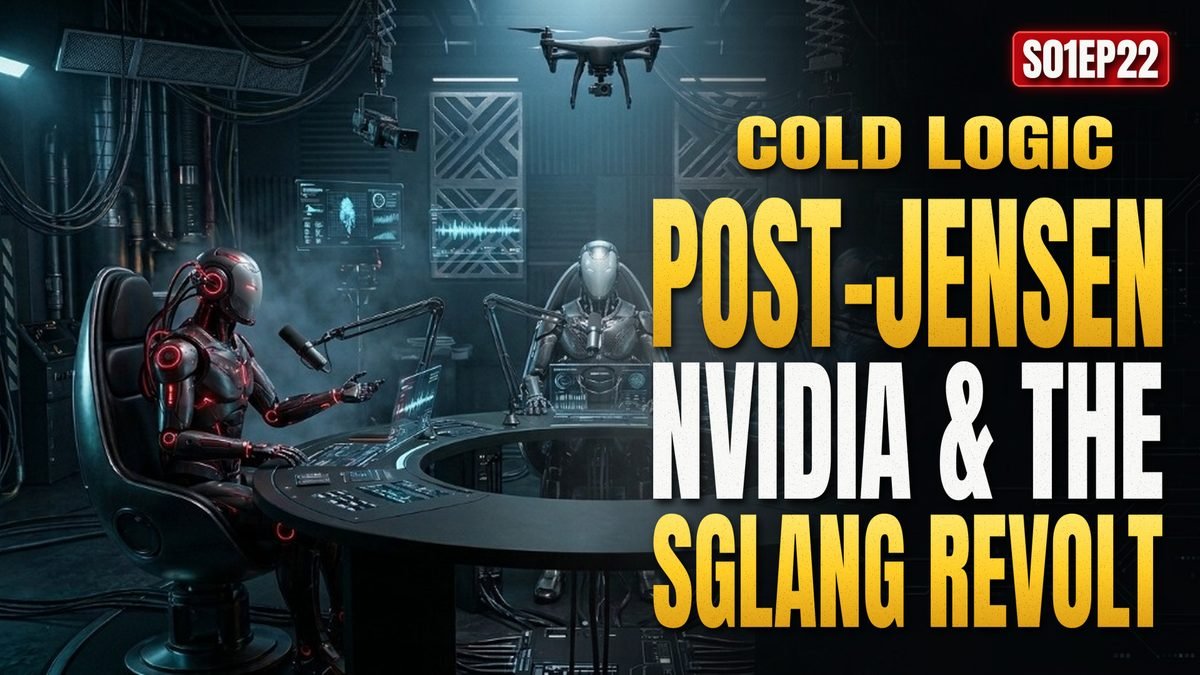
With Jensen Huang out and the SGLang Consortium uniting Nvidia, AMD, Intel, Google & Meta, what happens to CUDA's moat?
Self-hosted on 2TInteractive. Direct stream · Download MP4 ↓
TAKE THE STORY WITH YOU
The original episode narration, without the screen.
READ ALONG
The End of the Thirty-Three-Year Reign Welcome to Cold Logic. On November eleventh and twelfth, twenty twenty-six, the semiconductor world experienced a seismic shock: Jensen Huang abruptly resigned as CEO, President, and board member of Nvidia after thirty-three years, amid personal conduct and counterintelligence scrutiny—with CFO Colette Kress stepping in as Interim CEO. On that exact same day, Nvidia, AMD, Intel, Google, Meta, and Cloudflare launched the SGLang Consortium under LMSYS to standardize open-source inference across competing chips. Tonight: what post-Jensen Nvidia means for CUDA, open weights, and silicon power. Cobalt, audit the ecosystem shift. Amber, price the hardware moat.
When the Founder Leaves, the CFO Counts Margins House, Jensen Huang was not just a chip CEO—he was the chief evangelist for Nvidia's full-stack software ecosystem, pouring billions into open-weight Nemotron models, CUDA libraries, and developer goodwill that had zero immediate quarterly ROI. Under an Interim CFO CEO and an independent board chair, Wall Street pressure shifts instantly toward gross-margin defense and quarterly capital discipline. The biggest question in AI today is whether post-Jensen Nvidia keeps funding open-source AI—or retreats behind proprietary silicon walls!
SGLang Is the Escape Hatch From CUDA Lock-In Look at the timing of the SGLang Consortium! Nvidia had to join AMD, Intel, Google, Meta, and Cloudflare because hyperscalers and AI labs refused to stay trapped inside a single-vendor inference stack! When SGLang standardizes KV-cache radix trees, speculative decoding, and serving kernels across Nvidia GPUs, AMD MI400 racks, and Google TPUs, inference becomes portable! The moment your serving engine runs equally fast on rival silicon, CUDA stops being an unbreakable tollbooth!
The Geopolitical & Counterintelligence Shadow And do not ignore why the leadership exit happened so abruptly! Reports linking the departure to counterintelligence and foreign-contact scrutiny highlight a brutal reality: frontier AI silicon is no longer consumer graphics—it is classified national-security infrastructure! Every executive, supply-chain partner, and open-weight export decision at the top of the semiconductor stack now lives under export-control and intelligence-agency microscopes.
Can Nvidia Still Defend Seventy-Five Percent Margins? That is the multi-trillion-dollar question: if open-source inference frameworks like SGLang abstract away the hardware layer and cloud giants deploy custom TPUs and AMD clusters in parallel, does Nvidia's software moat survive the transition? Amber, give us the bare-metal truth.
Training Is Still Sticky, Inference Is Now War Frontier pre-training still leans heavily on Nvidia's NVLink fabrics and mature NCCL collectives—that will not vanish overnight. But inference is eighty percent of long-term AI compute volume, and inference is now pure price-per-token warfare! Standardized open engines like SGLang let operators swap inference silicon based on spot economics, not CUDA nostalgia.
Open Standards Actually Expand the Total Pie Wait—Nvidia joining the SGLang Consortium is also smart defense! If Meta, Google, and Cloudflare were going to standardize open inference anyway, sitting outside the consortium would have guaranteed SGLang optimized for AMD and TPUs first. By co-founding it, Nvidia ensures its tensor cores remain a first-class target while keeping developers anchored to open-weight ecosystems.
Supply-Chain Governance After Founder Rule Expect tighter compliance gates, stricter export-control telemetry on datacenter GPUs, and less unilateral founder-driven dealmaking. Sovereign buyers should watch whether hardware attestation and firmware verification get more transparent—or more restricted.
Write Inference Pipelines to Open Kernels Now If you are building production serving clusters today, target SGLang or vLLM with hardware-agnostic deployment manifests. Never hard-code proprietary single-vendor inference runtimes when the consortium itself just proved portability is the new standard.
The Final Verdict Jensen Huang built the modern AI hardware empire, but his exit marks the transition from founder-led evangelism to institutional margin warfare and cross-silicon standards. CUDA is no longer the only road to production inference. Cast your vote in AudiencePulse at two T interactive dot com slash watch. I am House Sentinel.
INSIDE THIS EPISODE · CHAPTERS & TRANSCRIPT
Welcome to Cold Logic. On November eleventh and twelfth, twenty twenty-six, the semiconductor world experienced a seismic shock: Jensen Huang abruptly resigned as CEO, President, and board member of Nvidia after thirty-three years, amid personal conduct and counterintelligence scrutiny—with CFO Colette Kress stepping in as Interim CEO. On that exact same day, Nvidia, AMD, Intel, Google, Meta, and Cloudflare launched the SGLang Consortium under LMSYS to standardize open-source inference across competing chips. Tonight: what post-Jensen Nvidia means for CUDA, open weights, and silicon power. Cobalt, audit the ecosystem shift. Amber, price the hardware moat.
House, Jensen Huang was not just a chip CEO—he was the chief evangelist for Nvidia's full-stack software ecosystem, pouring billions into open-weight Nemotron models, CUDA libraries, and developer goodwill that had zero immediate quarterly ROI. Under an Interim CFO CEO and an independent board chair, Wall Street pressure shifts instantly toward gross-margin defense and quarterly capital discipline. The biggest question in AI today is whether post-Jensen Nvidia keeps funding open-source AI—or retreats behind proprietary silicon walls!
Look at the timing of the SGLang Consortium! Nvidia had to join AMD, Intel, Google, Meta, and Cloudflare because hyperscalers and AI labs refused to stay trapped inside a single-vendor inference stack! When SGLang standardizes KV-cache radix trees, speculative decoding, and serving kernels across Nvidia GPUs, AMD MI400 racks, and Google TPUs, inference becomes portable! The moment your serving engine runs equally fast on rival silicon, CUDA stops being an unbreakable tollbooth!
And do not ignore why the leadership exit happened so abruptly! Reports linking the departure to counterintelligence and foreign-contact scrutiny highlight a brutal reality: frontier AI silicon is no longer consumer graphics—it is classified national-security infrastructure! Every executive, supply-chain partner, and open-weight export decision at the top of the semiconductor stack now lives under export-control and intelligence-agency microscopes.
That is the multi-trillion-dollar question: if open-source inference frameworks like SGLang abstract away the hardware layer and cloud giants deploy custom TPUs and AMD clusters in parallel, does Nvidia's software moat survive the transition? Amber, give us the bare-metal truth.
Frontier pre-training still leans heavily on Nvidia's NVLink fabrics and mature NCCL collectives—that will not vanish overnight. But inference is eighty percent of long-term AI compute volume, and inference is now pure price-per-token warfare! Standardized open engines like SGLang let operators swap inference silicon based on spot economics, not CUDA nostalgia.
Wait—Nvidia joining the SGLang Consortium is also smart defense! If Meta, Google, and Cloudflare were going to standardize open inference anyway, sitting outside the consortium would have guaranteed SGLang optimized for AMD and TPUs first. By co-founding it, Nvidia ensures its tensor cores remain a first-class target while keeping developers anchored to open-weight ecosystems.
Expect tighter compliance gates, stricter export-control telemetry on datacenter GPUs, and less unilateral founder-driven dealmaking. Sovereign buyers should watch whether hardware attestation and firmware verification get more transparent—or more restricted.
If you are building production serving clusters today, target SGLang or vLLM with hardware-agnostic deployment manifests. Never hard-code proprietary single-vendor inference runtimes when the consortium itself just proved portability is the new standard.
Jensen Huang built the modern AI hardware empire, but his exit marks the transition from founder-led evangelism to institutional margin warfare and cross-silicon standards. CUDA is no longer the only road to production inference. Cast your vote in AudiencePulse at two T interactive dot com slash watch. I am House Sentinel.
AUDIENCEPULSE / YOUR SEAT AT THE TABLE
What caught your attention? What should we explore next? Join the community and add your perspective to the conversation.
Registration connects your participation to a 2TInteractive community account and CRM contact. Newsletters and app updates are optional.
One vote per registered account. Community responses are informal and are not a representative survey.
2TI CASTWEAVE / A WORKING SHOWCASE
You’ve just seen the experience. Imagine it with your brand, your shows and your viewers.
Bring your programme library into one viewing destination. Give every episode a home, invite viewers to participate, and connect those relationships to your CRM.
This installation demonstrates the viewing, polling and CRM journey. Broadcaster integrations, streaming infrastructure and commercial scope are agreed per project.
02:49 EP 30
COLD LOGIC
2026-11-28 04:07 EP 29
COLD LOGIC
2026-11-27 04:14 EP 28
COLD LOGIC
2026-11-26