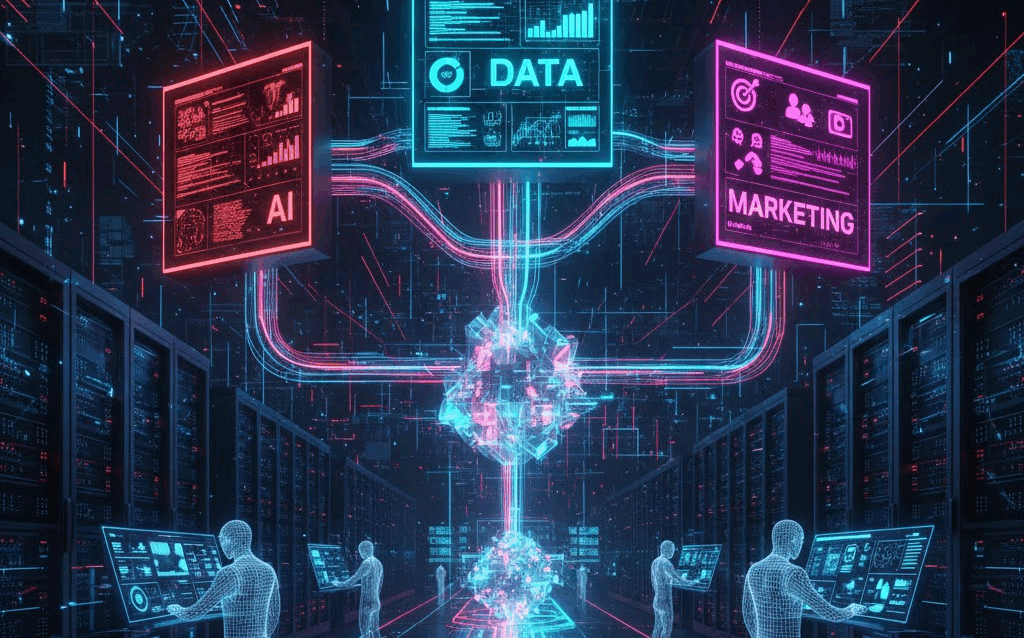
H3: Our Complete Tech Stack: Integrating AI, Data, and Marketing
Connecting the Dots is more than just a catchy phrase; it’s the fundamental principle behind modern business success. In an era of information overload and specialized tools, the real competitive advantage doesn’t come from having the best individual technologies, but from how seamlessly they work together. The most powerful business strategies emerge at the intersection of disparate fields, where artificial intelligence, robust data infrastructure, and targeted marketing converge to create something greater than the sum of their parts. This integrated approach transforms isolated functions into a cohesive, intelligent engine for growth.
This article will explore how this philosophy is applied in practice, from solving immediate data dilemmas to building the self-optimizing enterprises of tomorrow.
H3: The Ultimate Tech Showcase: A Symphony of Integration
Imagine a retail client facing a common challenge: their online ads are underperforming, their customer service is overwhelmed, and their inventory management is a guessing game. Individually, these are marketing, operations, and supply chain issues. But through an integrated lens, they are a single, solvable data problem.
H4: How We Seamlessly Integrate AI, Data, and Marketing for Clients
Our approach begins by building a unified data foundation. We integrate the client’s e-commerce platform, CRM, ad accounts, and inventory systems into a centralized data warehouse. This becomes the “single source of truth.”
Next, predictive analytics and AI models go to work on this unified data:
- Customer Lifetime Value (CLV) Prediction: AI analyzes past purchase behavior, browsing history, and engagement to score each customer on their potential long-term value.
- Dynamic Personalization: The marketing platform uses these AI-driven insights to deliver hyper-personalized email campaigns and website content. A high-CLV customer might see recommendations for premium products, while a window-shopper receives a targeted discount.
- Smart Inventory Allocation: The system automatically correlates real-time sales data from marketing campaigns with inventory levels, alerting the supply chain team to restock trending items before they sell out.
The result? Marketing spend is allocated efficiently towards high-value customers, customer service has a 360-degree view of the customer, and stock-outs are minimized. This isn’t three separate solutions; it’s one integrated system where each component amplifies the others.
H3: Problem-Solving: Breaking Down Data Silos for Unified Insights
Many organizations are sitting on a goldmine of data but can’t access it because it’s trapped in departmental silos. The marketing team uses one analytics tool, sales uses another CRM, and finance operates on a separate ERP system. This fragmentation leads to inconsistent reporting, duplicated efforts, and poor decision-making.
H4: How IT Consulting & Data Analytics Create a Single Source of Truth
The journey from data chaos to clarity is a deliberate process that blends strategic IT consulting with advanced data analytics.
- Assessment and Blueprinting (The IT Consulting Role): First, we conduct a full audit of all existing systems, data sources, and workflows. The goal is to understand the “why” behind the silos and map out a blueprint for integration. This involves selecting the right technology stack—like a cloud data warehouse (e.g., Snowflake, BigQuery)—and designing a secure, scalable architecture.
- Data Ingestion and Cleansing (The Analytics Role): Using tools like Apache Airflow or Fivetran, we build pipelines to automatically pull data from all source systems into the central warehouse. Here, the data is cleaned, standardized, and transformed. This step is crucial; it turns messy, raw data into a reliable asset.
- Governance and Accessibility: We establish clear data governance protocols—defining who can access what data and for what purpose. Finally, we implement a user-friendly Business Intelligence (BI) platform, like Tableau or Power BI, on top of the clean data. Now, every department can create reports from the same, trusted dataset.
The outcome is a single source of truth. When marketing and sales look at the same customer conversion dashboard, they can collaboratively diagnose funnel problems and align their strategies, driving revenue growth with a unified vision.
H3: Future Vision: Building Toward an Autonomous Enterprise
The logical conclusion of integrating AI, data, and automation is the evolution towards a “self-optimizing” business. This isn’t science fiction; it’s the next frontier of operational excellence, where systems don’t just report on what happened but proactively recommend and even execute improvements.
H4: Creating a ‘Self-Optimizing’ Business: AI, Automation & Analytics
A self-optimizing business operates on a continuous loop of analysis, decision, and action, all with minimal human intervention. This is made possible by the deep intersection of its core technologies:
- Analytics acts as the nervous system, constantly monitoring performance metrics across the organization—from website traffic and production line efficiency to cash flow.
- AI and Machine Learning serve as the brain. They process the data from the analytics layer to detect patterns, predict outcomes, and generate prescriptive recommendations. For instance, an AI could forecast a spike in demand for a product and automatically adjust procurement orders.
- Automation functions as the muscles. It carries out the decisions made by the AI. Robotic Process Automation (RPA) bots can handle invoice processing, while automated marketing platforms trigger entire customer nurture sequences based on AI-scored lead behavior.
Consider a digital advertising example: An AI model continuously analyzes campaign performance, identifying that ads featuring video creative are outperforming static images for a specific demographic. An automated rule then reallocates 80% of the daily budget to the high-performing video ads without a marketer having to lift a finger. The system has self-optimized for better ROI.
H3: Conclusion: Achieving a Fully Connected Business Ecosystem
The journey from disconnected operations to an integrated, intelligent enterprise is the defining business challenge of this decade. It starts with solving the foundational problem of siloed data to create a single source of truth. This clean, unified data then fuels powerful AI and marketing integrations that drive immediate growth and efficiency. Ultimately, this lays the groundwork for the future: a resilient, self-optimizing business that can adapt and thrive in an ever-changing market.
The dots are all there. The power lies in connecting them. By weaving together IT infrastructure, data analytics, and AI-driven automation, you’re not just adopting new tools—you’re building a smarter, more responsive, and fundamentally more competitive organization.