Sovereign content production studio
Scoped deployment · Hardware-bound module leases
2TI SceneWeave
A local-first production studio where the wires, the script, the voice, the plates and the master live on one timeline — on hardware you own. Built for newsrooms, broadcasters, post houses and creators who want to replace five disconnected cloud tools with one reproducible pipeline.
The fit
What SceneWeave is.
One core manifest plus pluggable production modules. Clients licence only the stations they run, bound to local workstation hardware with zero token-metered cloud custody.
What ships
Commercial shape
Solo Creator, Newsroom, Post House, Arabic Desk, Karaoke Studio, Agency
Licensed packs with TemplateGate windows ($29/mo single template indicative)
On-prem Ed25519 hardware-bound; 300–6,000 render-min/mo allowances
No invented public SKU prices or fake discounts. Final bundle tier, render-minute compute allowance, template leases and human supervision hours are confirmed in the scoped quotation.
Six production bundles
Same studio, six production shapes.
Each bundle activates only the modules required for that workflow, with fair-use monthly render-minute ceilings instead of per-token billing.
Newsroom
Daily bulletin from wires to master: dossier scoring, word-budgeted scripting, cloned voice, lip-sync, Arabic support and dual-ratio delivery.
1,800 render-min/mo included · Daily editorial workflow
Arabic Desk
Arabic-first newsroom and docuseries: native RTL typography, MSA & dialect navigation, clean subtitle track vs. vocalized TTS phonetics, and bilingual plates.
1,800 render-min/mo included · Latin numerals default
Solo Creator
One operator writing, voicing, plating and delivering recurring episodes on a single GPU workstation without a cloud render farm.
300 render-min/mo included · Podcast & creator
Post House
High-throughput rendering, ReCaVSR 4× video super-resolution, motion assembly and delivery mastering for client productions without authoring seats.
3,600 render-min/mo included · Docuseries & finishing
Karaoke Studio
Word-level lyric alignment, stem isolation, Remotion synchronized lyric stage graphics and dual-ratio 16:9 + 9:16 master export.
600 render-min/mo included · Batch queue pipeline
Agency
Full multi-client workspace with hard tenant isolation at the project boundary, per-client module entitlements, contracts, quotas and deliverables.
6,000 render-min/mo included · Full slate
Architectural shift
Five tools pretending to be one — replaced by one timeline.
Measured end-to-end on our live geopolitical testbed (THE CHOKEPOINT / نقطة اختناق): one five-minute episode runs in ~12 minutes wall clock (~0.1 kWh) locally.
Five cloud subscriptions per episode
Traditional teams pay separately for feed monitors, cloud LLMs, per-character TTS voices, generic template editors and manual NLE cutting — then awkwardly centre-crop widescreen masters into vertical social clips that slice the anchor in half.
Fragmented state, unpredictable per-token bills, and unverified source logos on air.
Wires → Script → Voice → Plates → Master
SceneWeave scores 614 feeds against the show brief (~2 s CPU), drafts scripts to strict word budgets (~4.5 min local LLM), maps phonetics (< 1 s), synthesizes local XTTS voices (~20 s), renders Remotion plates (~90 s), and assembles via FFmpeg.
Measured runtime gauge prevents runaway scripts before rendering begins.
Subject-aware streams & gated plates
Rundown, NLE Timeline and ATEM Switcher edit the same versioned document. Separate 16:9 and 9:16 framing boxes keep the anchor and graphics clean in both ratios, while TemplateGate enforces plate licences before any render runs.
Rebuilds preserve operator layout overrides and revision history.
Live studio views
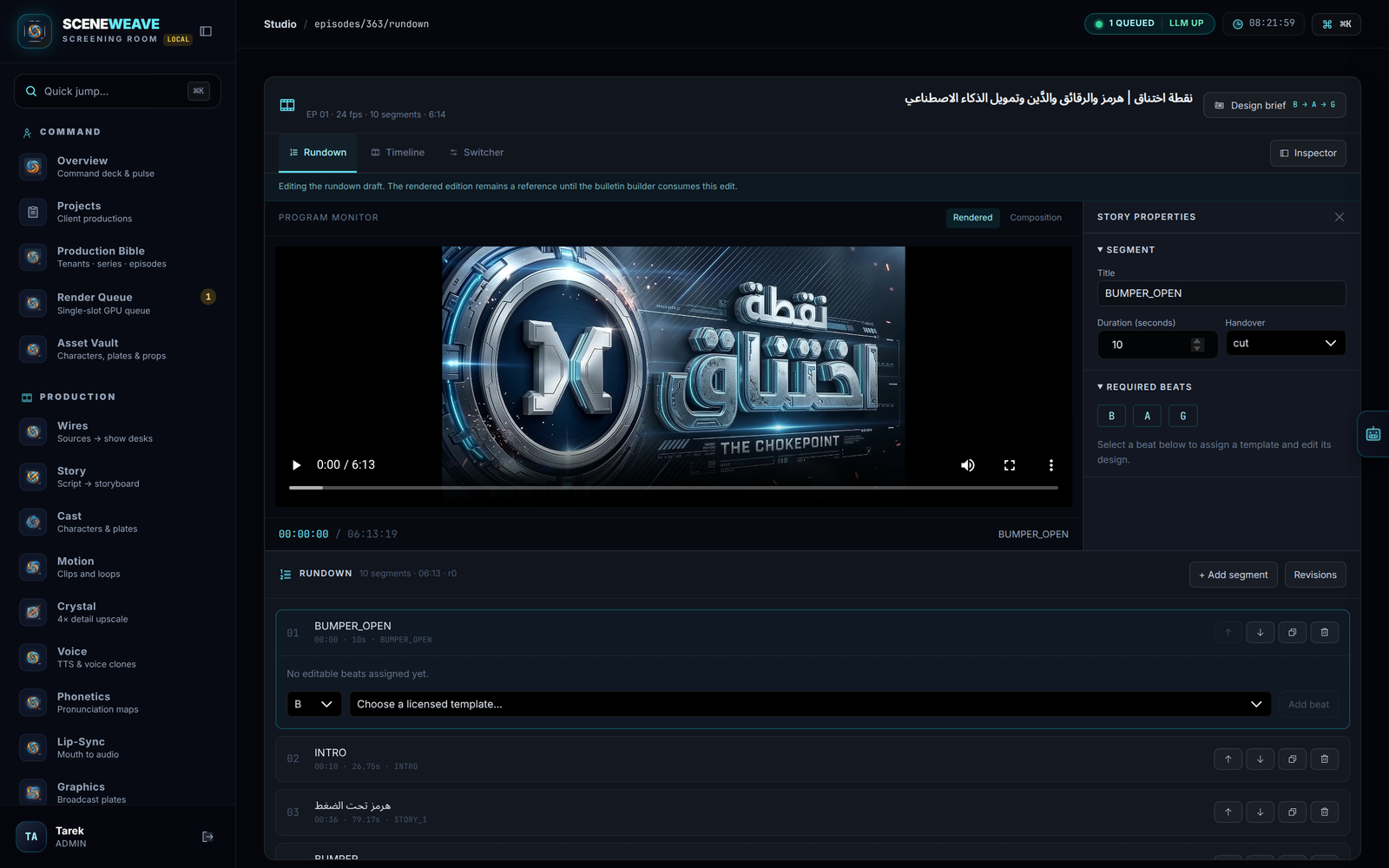
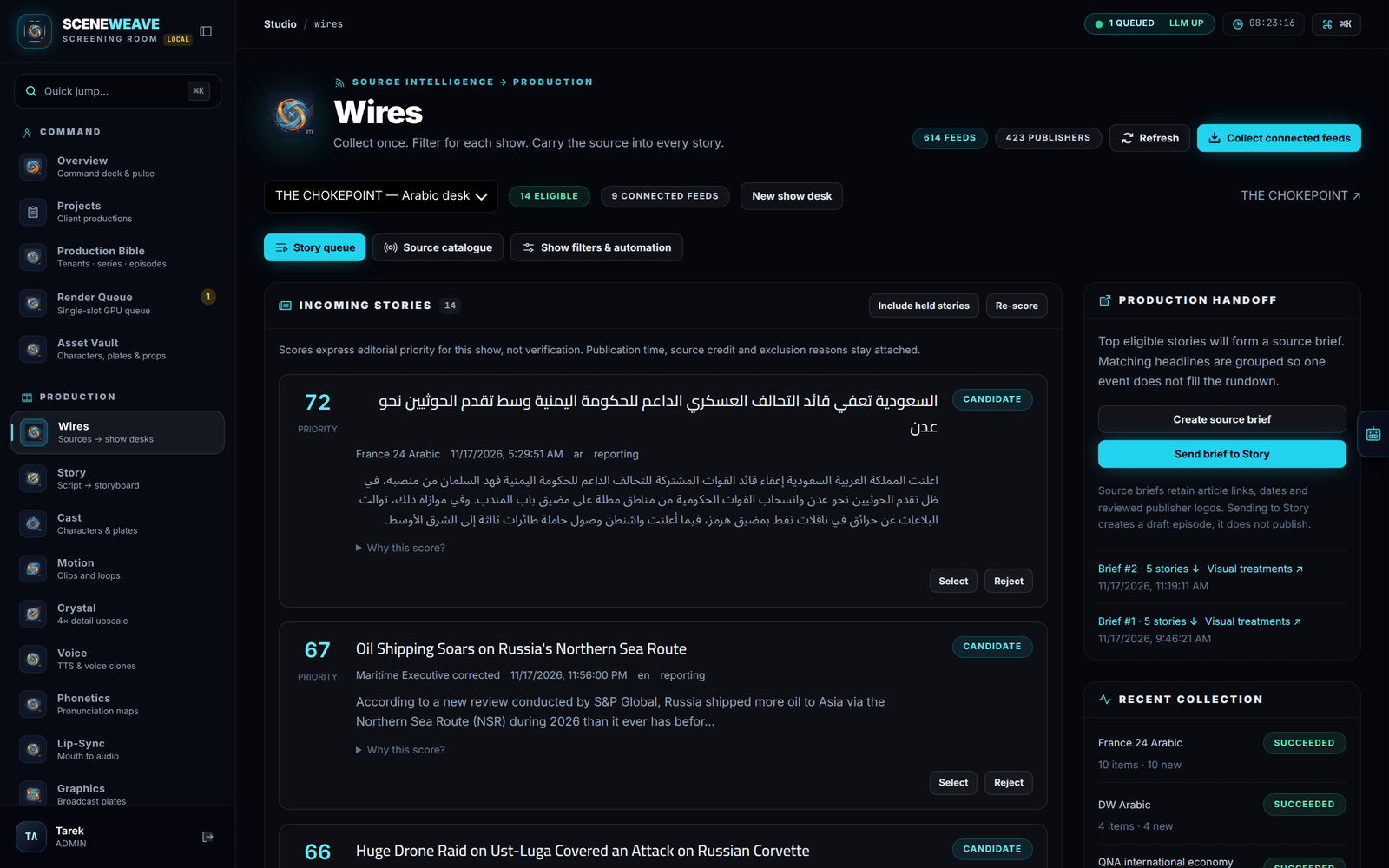
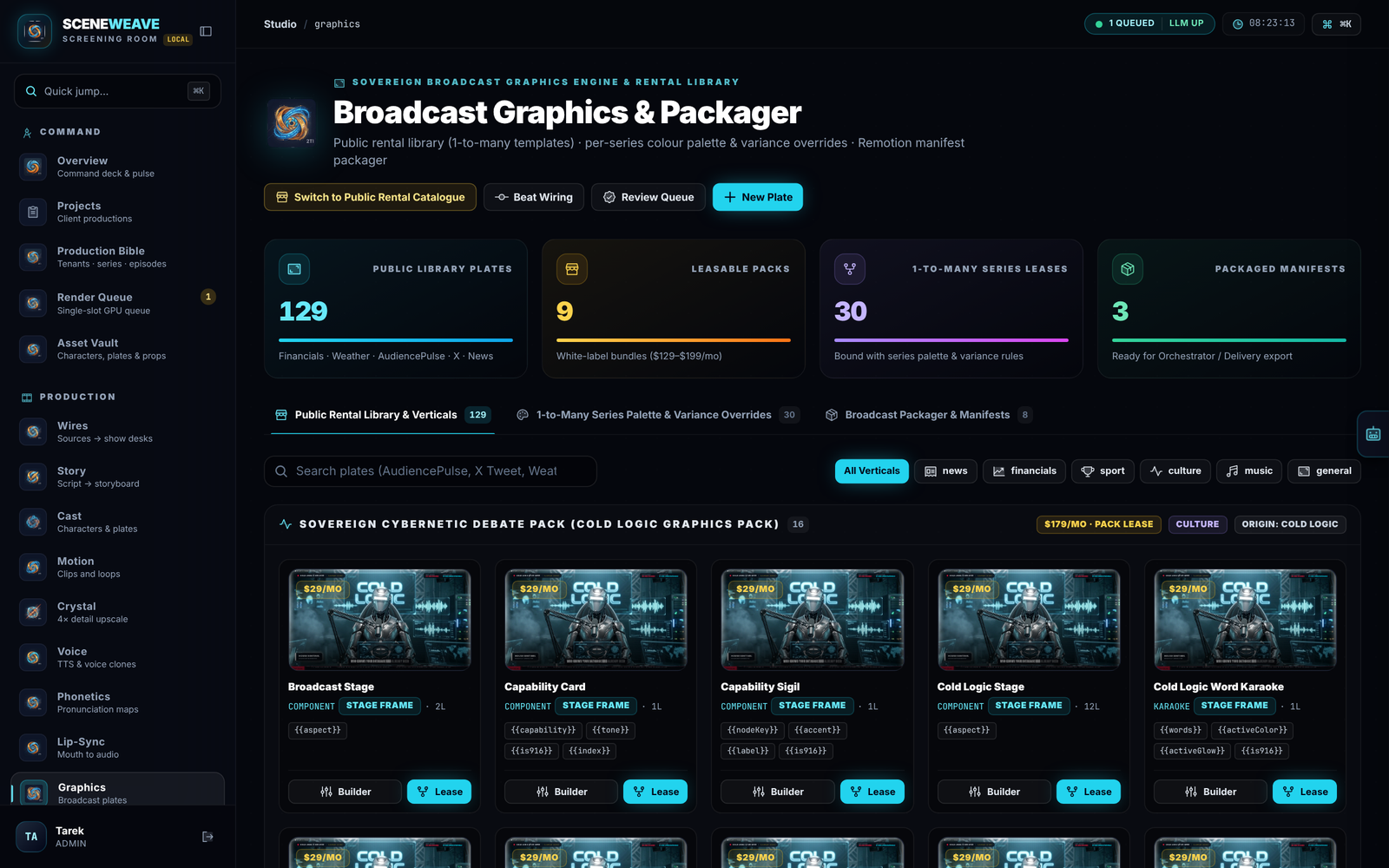
Captured from the live SceneWeave workstation on THE CHOKEPOINT.
Authentic captures from sceneweave.local on Episode #363. Longer workrooms scroll vertically inside each frame.
BUMPER_OPEN, INTRO, STORY_1…), shared Program Monitor, required B/A/G beat assignments and named template variables.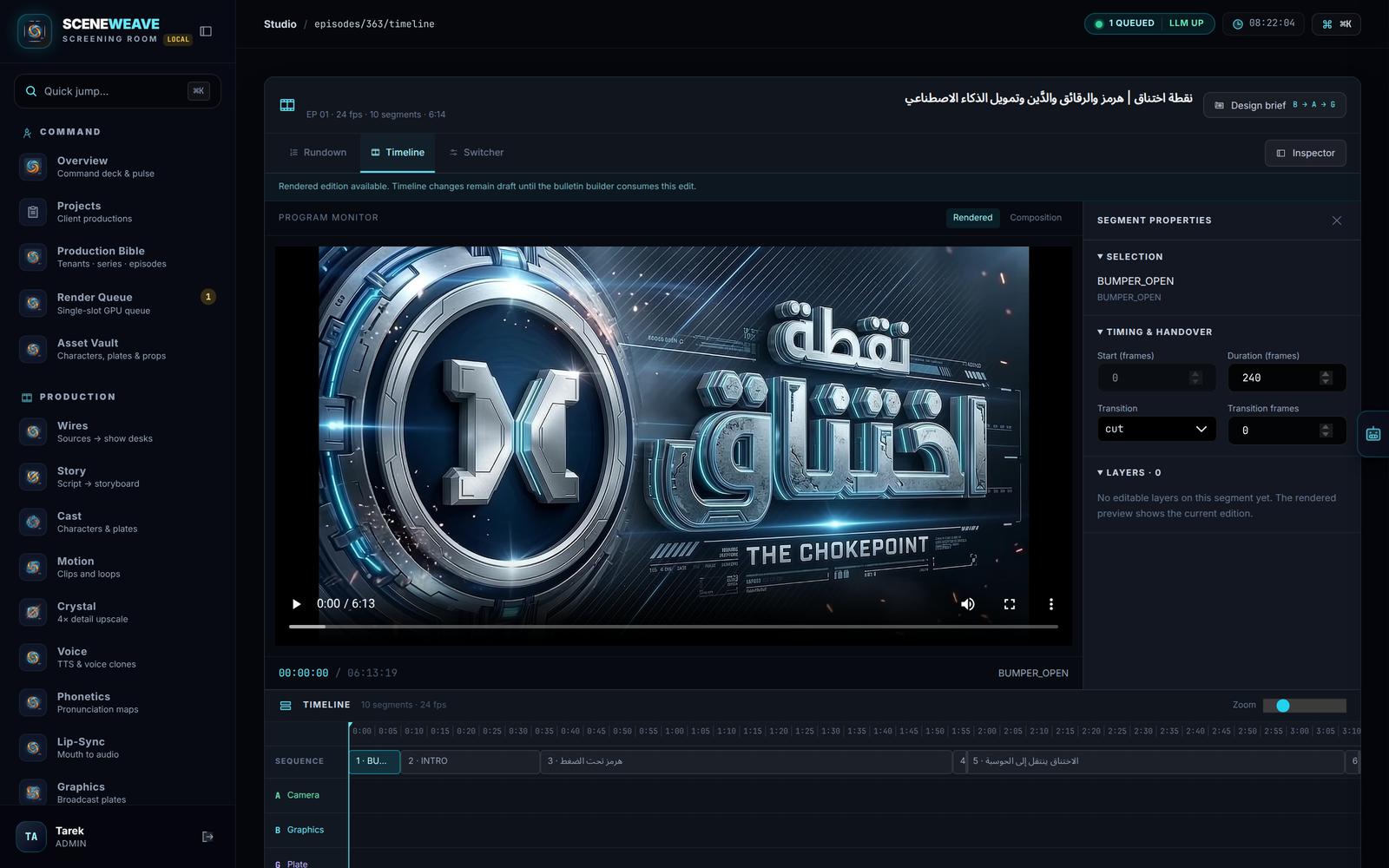
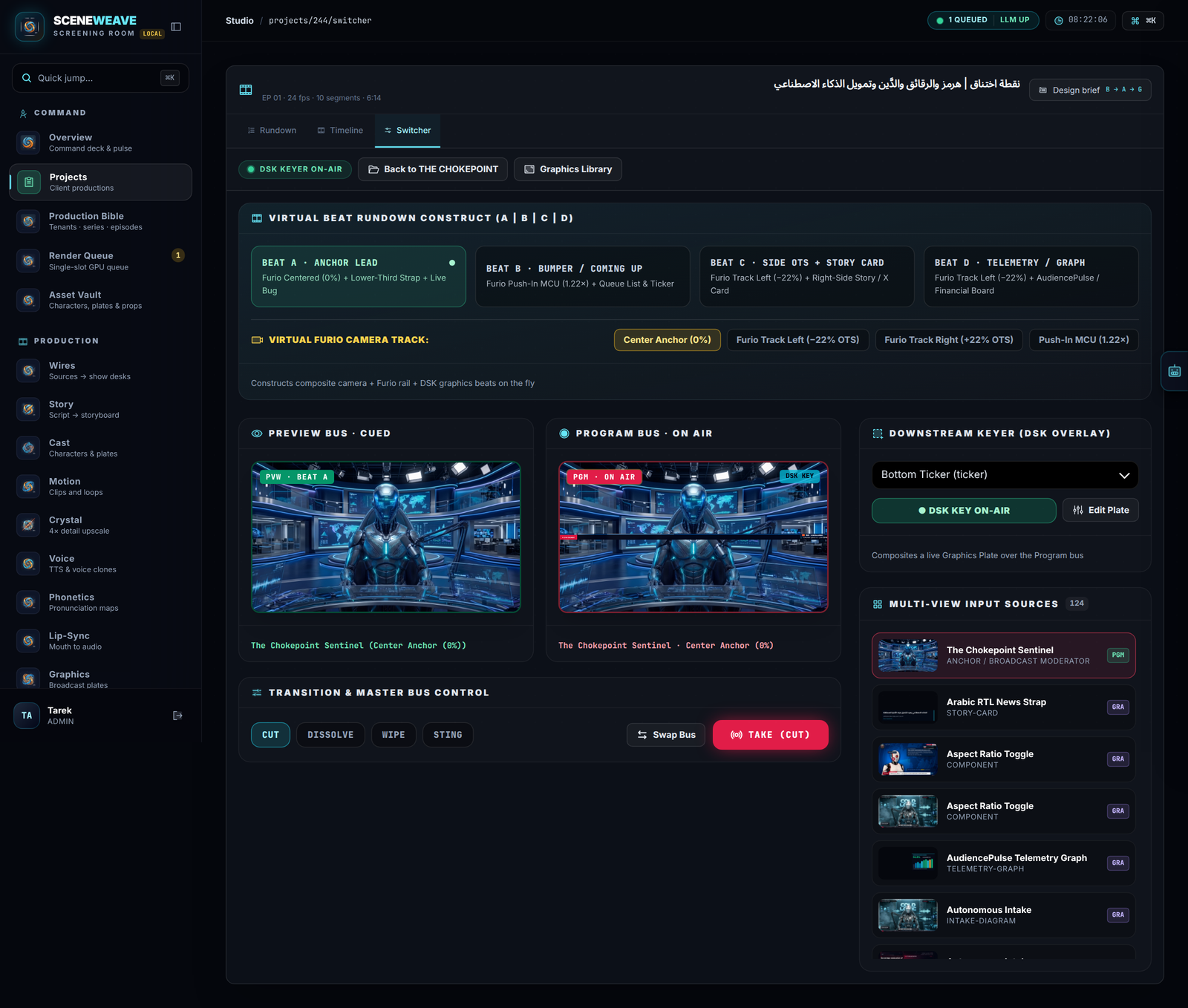
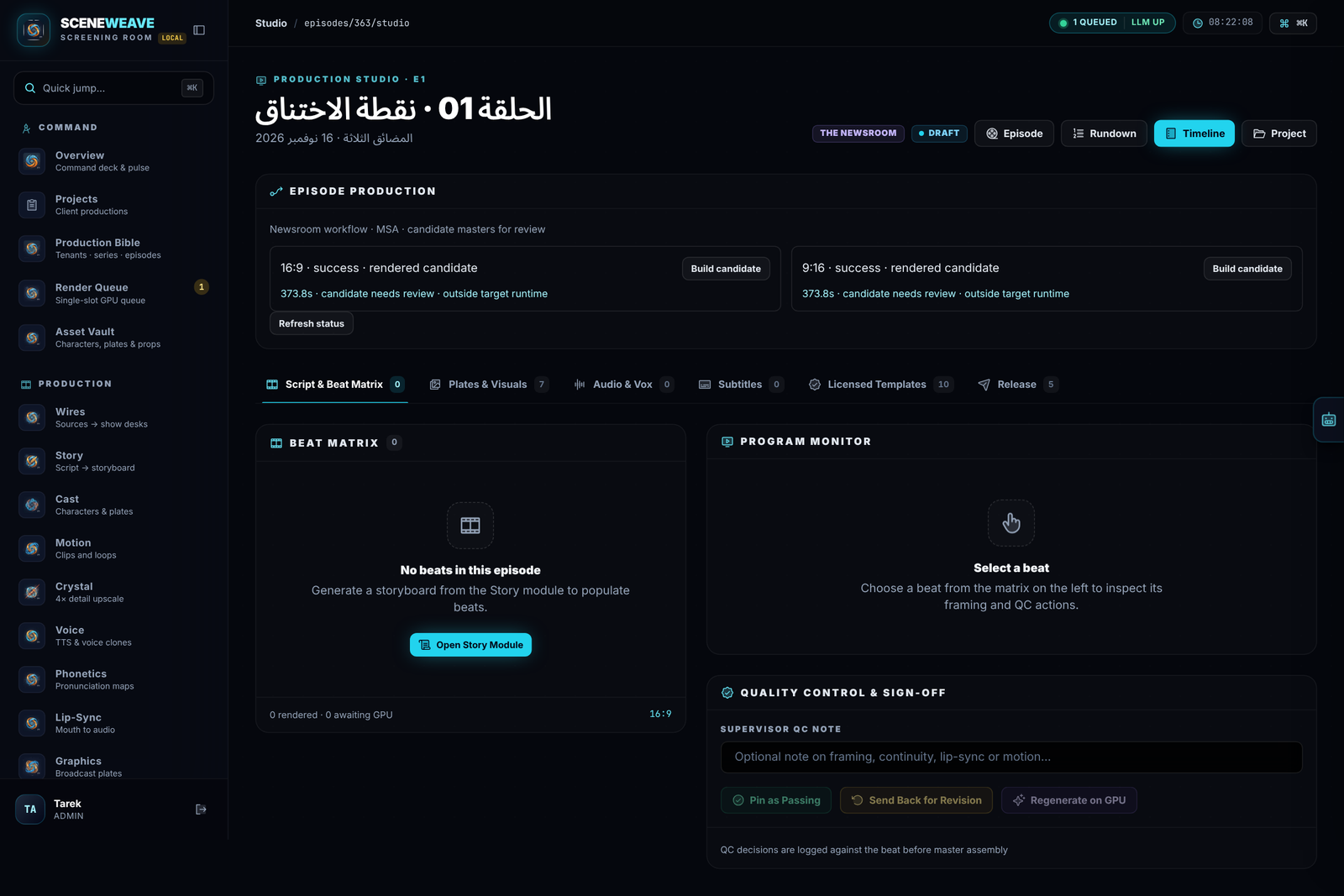
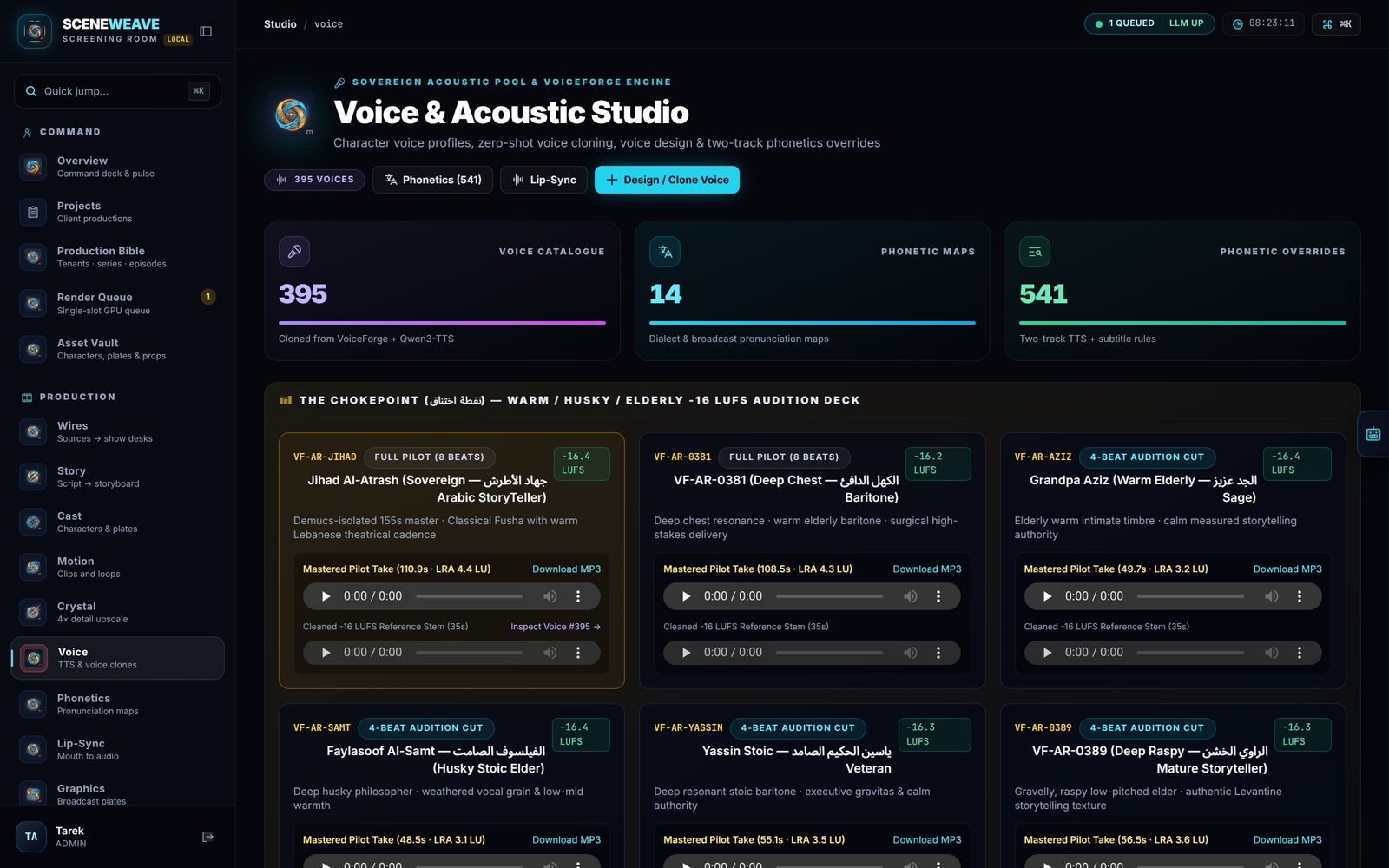
-16 LUFS reference auditions paired with 14 phonetic maps and 541 overrides so TTS speaks diacritized text while on-screen captions stay clean.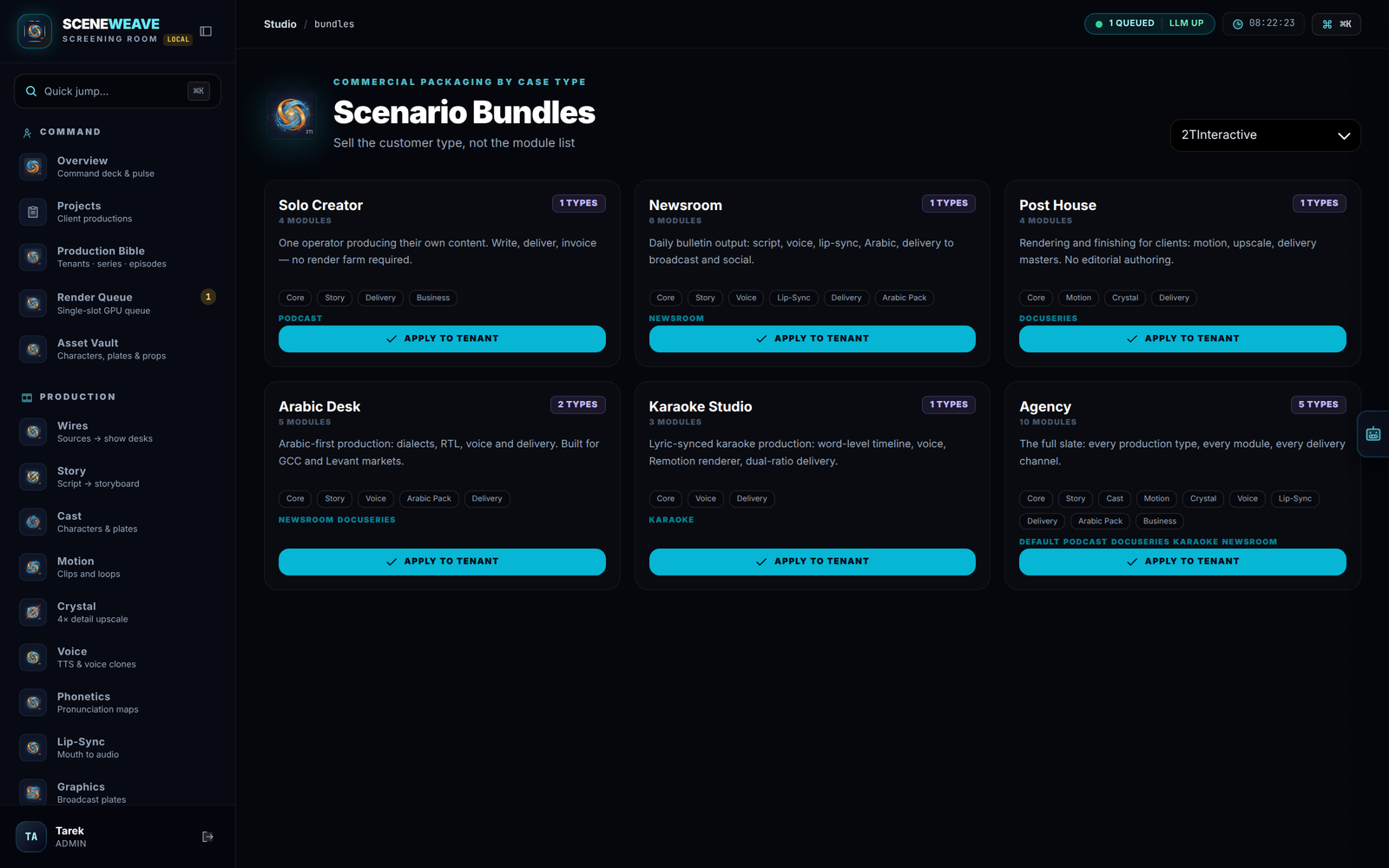
Licensing & sovereignty
Sovereign by construction.
Every operational capability sits behind an explicit kernel check — never client-side UI hiding alone.
Hardware-bound module leases
Powered by two-ti-licensing, each module slug verifies an Ed25519 lease pinned to the workstation hash. Unlicensed or expired modules and plates cannot be triggered at the kernel.
Not multi-tenant SaaS
Each agency or broadcaster deployment keeps strict client and project isolation on local MariaDB or SQLite storage, plus hash-indexed MAM assets and immutable configuration revisions.
Licensed seats, not token meters
Bundled scripting (Ollama), TTS (XTTS / Qwen3-TTS), image generation (ComfyUI / SDXL / Wan2.2) and Remotion rendering run on your local GPU with zero cloud egress.
Related surfaces
One portfolio, clear boundaries.
SceneWeave prepares and masters episodes locally; CastWeave handles owned streaming catalogues; Sovereign Meet powers live reviews.
Expand through the suite
From local mastering to reviewed delivery.
Pair SceneWeave with PulseCast for outbound scheduling, CastWeave for owned OTT channels, and Operations Desk for client delivery tracking. Delivery bridges require explicit configuration and review; nothing auto-publishes without approval.